Pisa with Kids: Leaning Tower Fun, Medieval Walls and Easy Family Stops
Pisa with Kids: Leaning Tower Fun, Medieval Walls and Easy Family Stops is designed for families who want to enjoy Tuscany without turning every day into a race. Pisa is one of Tuscany’s easiest cities to explain to a child because the main landmark already looks like something from an illustrated story. Yet the city is much more useful for families than a quick Leaning Tower photo: the official tourism site has a dedicated children’s itinerary featuring green spaces, the medieval walls and the Botanical Garden.
Pisa can be a half-day stop, a full day or a base for Lucca and the coast. Families arriving by train should allow time for the walk or local transport between Pisa Centrale and Piazza dei Miracoli. Those arriving by car should park outside restricted central streets and walk in.
How to plan it well
Family travel in Tuscany works best when the schedule has space. Historic centres can be compact but cobbled, summer afternoons can be hot, and even short drives may include parking, restricted traffic zones and a final walk uphill. Build each day around one or two priorities, then leave enough room for a playground, a long lunch, a gelato stop or a swim. That flexibility is not a compromise; it is what allows both adults and children to experience the region rather than simply move through it.
Before each day, check the official website for any attraction with timed entry, seasonal opening, age restrictions or height limits. For cities, check the local ZTL and parking information rather than following a navigation app into the historic centre. In the countryside, assume that services are more spread out and carry water and a small snack even when lunch is planned.
Best things to do and how to fit them into a family trip
Give children time to react to the Leaning Tower
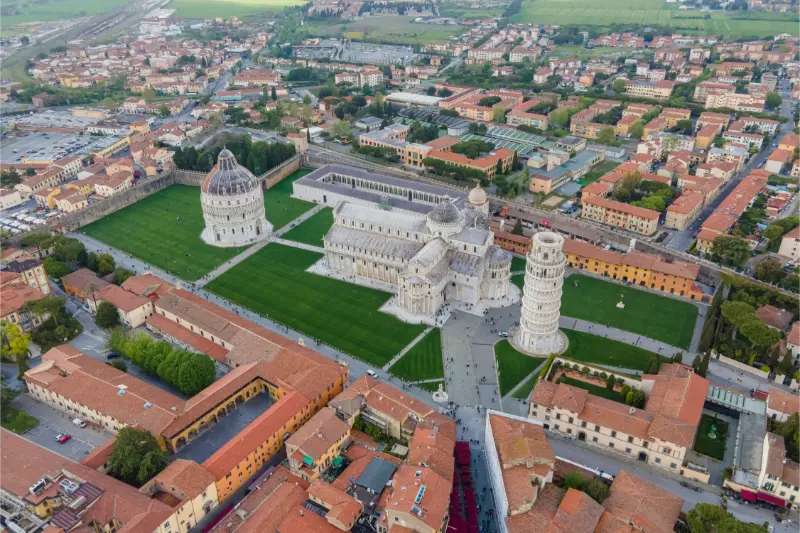
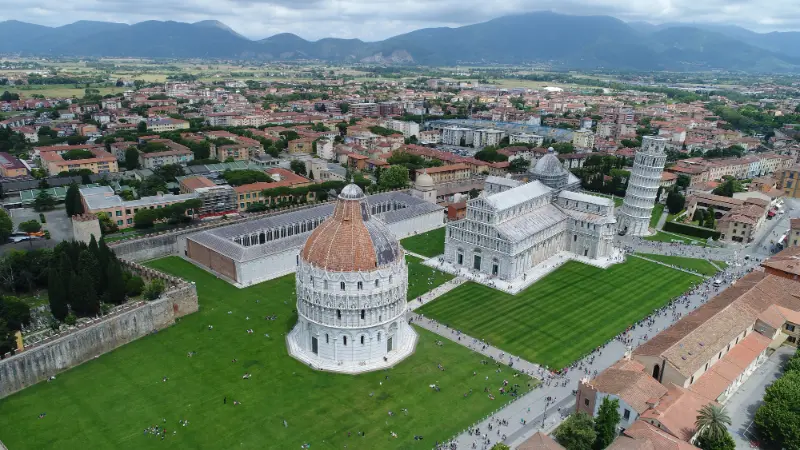
The first view of the tower is the whole point for many young visitors. Let children notice the angle, take the silly photographs and walk around the lawn before moving into historical explanations. The cathedral and baptistery make the square feel like a complete medieval complex rather than a single odd building.
If you plan the tower climb, confirm current age and safety rules. Do not buy a climb ticket for a child who is uncertain about narrow stairs or heights simply because the landmark is famous.
Use the lawn as a pause, not a picnic area
The green space of Piazza dei Miracoli gives families visual breathing room, but it is part of a monumental complex rather than an ordinary city park. Children can pause and look at the buildings, yet families should follow local rules about where sitting and food are permitted.
For a real picnic or run-around break, use one of Pisa’s public green spaces instead.
Walk the medieval walls
Pisa’s city walls provide a completely different perspective, and the official tourism site includes wall-related experiences in its children’s itinerary. Looking down over roofs and toward monuments turns the city into a map children can understand.
Access points and opening conditions can change, so check the current wall website or city tourism information before planning the walk as a fixed part of your day.
Visit the Botanical Garden
Pisa’s Botanical Garden is closely tied to the university and is one of the oldest botanical institutions in Europe. It offers plants, shade, textures and outdoor movement after the stone of Piazza dei Miracoli. Children who have had enough of architecture often respond well to this shift.
The garden is close enough to the main monuments to add without a major detour. Check opening hours because university sites can have seasonal variations.
Follow the river for a quieter Pisa
The Arno gives Pisa a completely different personality. Walk from the central bridges along the Lungarni and look at the coloured facades reflected in the water. This section is less about attractions and more about letting the family see the city as a place where people live.
Keep young children close along roads and river edges. The best family sections are those where you can combine the view with a café or square stop.
Find Piazza delle Vettovaglie and Borgo Stretto
The arcades and market streets show a denser, everyday Pisa. Borgo Stretto is useful in hot weather because the arcades offer shade, while Piazza delle Vettovaglie gives the historic centre a lived-in feel.
Evenings can be lively, so families with very young children may prefer these streets earlier in the day.
Use Parco delle Concette for small-child downtime
Pisa’s official children’s itinerary highlights Parco delle Concette as a place for little ones to rest, play, picnic or read. This kind of stop can rescue a day that has become too monument-heavy.
Do not treat a playground stop as wasted sightseeing time. With children, it often buys another happy hour later.
Add Lucca if you have a second day
Pisa and Lucca are connected by train and make a strong family pairing. Pisa supplies the famous monument; Lucca supplies the walls, bicycles and calmer old-town rhythm. Sleeping in either city can work, depending on your wider route.
Check evening train times before assuming you can stay late. If you have luggage, storing it or checking in first is far easier than dragging it through both centres.
Eat simply and keep the timetable loose
Pisa has plenty of pizza, focaccia and pasta options around the centre. Avoid choosing a restaurant solely because it is closest to the tower. Walking ten minutes away from the main square often gives a calmer meal.
A family day is smoother when lunch does not depend on a long queue. Carry a small snack for the gap between timed tickets.
Decide whether Pisa is a stop or a base
Families often treat Pisa as an airport gateway, but it can be a practical base for Lucca, the coast and onward trains. If your flight uses Pisa Airport, spending the final night in the city can remove transfer anxiety.
For a short airport stay, prioritise transport convenience over a picturesque but awkward location deep in restricted streets.
Useful booking tools for this trip
Tours & experiences: For guided visits, attraction tickets and bookable experiences in Pisa, See tours & tickets
Where to stay with children
Families can stay near Pisa Centrale for transport convenience or nearer Piazza dei Miracoli for atmosphere. The best choice depends on whether Pisa is part of a rail trip, an airport stop or a full sightseeing base. Check lift access and room layout, especially in historic buildings.
When comparing accommodation, look beyond the headline price. A family room that genuinely sleeps everyone comfortably, a lift, predictable parking, breakfast on site and a location that lets you walk back for a break can be worth more than an extra star. In rural areas, ask about road access after dark, pool safety, restaurant opening days and whether there is somewhere simple to eat if children are tired.
Eating well without making meals complicated
Pisa is easy for casual family food. Pizza, cecina, pasta and gelato offer simple options, while the university character means there are many informal places. For a quieter meal, move away from the immediate tower zone and explore central streets closer to the Arno.
Tuscany is a good place to keep family food simple. Bread, focaccia, pasta, pizza, fresh fruit, mild cheeses and grilled dishes are easy to find, while local specialities give older children a chance to try something new without making every meal an experiment. Carrying one familiar snack is still useful on museum days, train journeys and long drives between villages.
Practical family tips
Pisa Airport is close to the city and connected to Pisa Centrale by the PisaMover. The train station then links well with Florence and Lucca. Families with a stroller should note that the historic centre is largely flat compared with Siena, which makes Pisa one of Tuscany’s easier urban days. Reserve the Leaning Tower only if the climb suits your children; otherwise the square itself is more than enough.

For younger children, a sturdy compact stroller and a lightweight carrier make a strong combination. For school-age children, give them a role: let them choose a tower, count contrada symbols, navigate one section of the walls or pick the afternoon gelato stop. For teenagers, build in ownership by letting them choose one beach, activity or meal. The more the trip feels shared, the less it feels like adults dragging children through an itinerary.
Useful official resources and related Tuscany Explorer guides
- Pisa official children’s itinerary
- Tuscany Explorer Pisa Guide
- Tuscany Explorer: Tuscany by Train
- Visit Tuscany: Families and children
- Tuscany Explorer Lucca Guide
Where to stay for this trip: Where to Stay in Tuscany: The Best Areas for Every Kind of Trip. Check prices & availability
A final thought
The best family trip through Tuscany is not the one with the most famous places checked off. It is the one where a child remembers a tower, a ferry, a bicycle ride, a strange statue or the taste of a warm piece of focaccia, while the adults still have time to notice the landscape and the art around them. Plan less than you think you can fit, choose bases carefully, and let the region supply the unexpected moments.