
Where to Stay in Florence: Best Neighborhoods and Hotels for a First Visit
Florence is compact enough that many central neighbourhoods work well, but the atmosphere changes within a few streets. A room beside Santa Maria Novella is excellent for an early train; a palazzo near the Duomo puts monuments at your door; Oltrarno feels more residential and evening-oriented; Santa Croce balances nightlife and history. The best choice depends less on distance and more on how you want mornings and evenings to feel.
For a first visit, I would prioritise walkability over a view. Florence’s historic centre is best experienced on foot, and every taxi or bus you remove from the day gives you more time for museums, aperitivo and unplanned detours. If you are driving, however, location must be considered together with the ZTL: a beautiful hotel can become stressful if you have not arranged legal access and parking in advance.
Santa Maria Novella: easiest for trains
The area around Piazza Santa Maria Novella is one of the most useful places to stay if Florence is part of a wider Italian journey. The station is close, the Duomo is an easy walk, and you can reach the Arno without crossing the whole centre with luggage.

The streets immediately around the station are busier and less romantic than the piazza itself, so look carefully at the exact address. A few hundred metres can change the atmosphere. For travellers with rolling luggage, that small difference may be more important than having a rooftop view.
See current options: Check prices & availability
Duomo and San Lorenzo: best for maximum centrality
Stay here if you want to step outside and be surrounded by Florence’s major monuments. The Duomo, Baptistery, Medici Chapels, Mercato Centrale and Accademia are all close, and evenings allow you to see the cathedral area after much of the daytime crowd has thinned.
The downside is intensity. Streets can be noisy, restaurants can be tourist-oriented, and a room facing a popular pedestrian route may not feel restful. Ask for an internal or upper-floor room if sleep matters more than street theatre.
See current options: Check prices & availability
Santa Croce: lively and atmospheric
Santa Croce has a social energy that suits travellers who want bars, restaurants and evening movement without being far from the Uffizi or Palazzo Vecchio. The basilica and square give the district a strong identity, while side streets lead quickly toward Sant’Ambrogio.
This is not the quietest option, especially on weekend nights. It is a good fit for couples and friends who expect to stay out after dinner, but less ideal for anyone who wants complete silence at 10 p.m.
Oltrarno and Santo Spirito: best for character
Cross the Arno and Florence feels subtly different. Santo Spirito, San Frediano and the streets around Palazzo Pitti have artisan workshops, local restaurants and a more lived-in rhythm, while still being within walking distance of the main monuments.
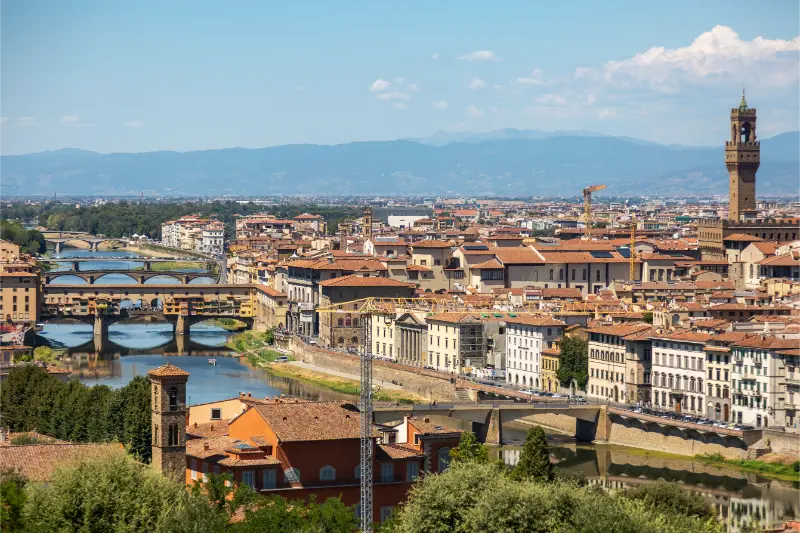
Choose carefully if mobility is limited: some attractive properties sit farther from the bridges, and climbing toward San Niccolò or the hills changes the effort. For many repeat visitors, however, Oltrarno is the part of Florence that makes the city feel less like a checklist.
See current options: Check prices & availability
Santa Croce to Sant’Ambrogio: good for food-minded travellers
The Sant’Ambrogio side of the centre is useful if markets, neighbourhood cafés and a slightly more everyday atmosphere matter to you. It remains close enough to walk to the Duomo but feels less dominated by the station and luxury-shopping streets.
Morning routines are especially pleasant here: coffee, the market, then museums. It is also a good direction if you plan to visit the synagogue or continue toward the eastern side of the city.
Outside the centre: when it makes sense
Staying outside Florence’s historic core can save money and simplify parking. Areas near tram lines or on the city’s edges can work well for longer stays, families and travellers with a car they do not want to move every day.
The compromise is atmosphere. If this is your only visit and you have just two nights, I would normally pay more to stay central. If you have five nights or are using Florence as a base, extra space and easier transport can be more valuable.
Places worth considering
Hotel Santa Maria Novella — faces Piazza Santa Maria Novella and is close to the railway station while remaining within easy walking distance of the Duomo and Uffizi. Check rates and availability prices & availability
Brunelleschi Hotel — occupies a highly central location near the Duomo and is useful for travellers who want to minimise walking between major sights. Check rates and availability prices & availability
Hotel degli Orafi — sits on the Lungarno close to the Uffizi and Ponte Vecchio, a particularly atmospheric position for a short cultural stay. Check rates and availability prices & availability
These are examples rather than a fixed ranking. Availability, services and rates change, so compare the location and conditions for your dates before booking.
Useful official information
For ZTL and mobility information, consult the official Feel Florence tourism portal before driving into the centre.
How to choose the right base
The strongest Tuscany itineraries usually begin with the right base rather than the longest list of places. If you want museums, restaurants and evening walks, stay in a city and use trains for day trips. If you want hill towns, vineyards and sunrise drives, choose the countryside and accept that a car becomes part of the experience. Coast and island trips work differently again: the quality of the beach, parking and ferry logistics can matter more than proximity to Florence. Before booking, write down the three places you most want to see and check the real travel time from your accommodation at the hour you expect to travel. Tuscany looks compact on a map, but winding roads, ZTL zones and hill-town parking can turn a short distance into a slow transfer.
What to check before booking
Do not choose accommodation only from room photographs. Check the exact location, whether breakfast and parking are included, the final access road, air conditioning if travelling in summer, and whether there is a lift if stairs are difficult. In rural properties, ask how far the nearest restaurant is and whether dinner is available on site. In historic centres, verify whether taxis can reach the door and whether the property lies inside a restricted traffic zone. Cancellation conditions matter too, especially if your trip includes ferries or several prepaid activities. A beautiful stay is much easier to enjoy when the practical details match the way you actually travel.
A note on prices and seasonality
Accommodation prices in Tuscany can change dramatically by season, day of the week and local events. Florence during major fairs, Siena around the Palio, the coast in August and wine areas during harvest can all behave differently from an ordinary midweek stay. Rather than quoting a fixed nightly price that will soon be wrong, compare the total cost for your exact dates, including parking, breakfast, city tax and any resort fees. Booking a slightly more expensive room in the right location can be cheaper overall if it removes taxis, parking charges or hours of driving. Spring and autumn often offer the best balance of atmosphere and availability, but popular countryside properties can still fill months ahead.

How many nights should you stay?
For a first trip, changing hotel every night usually creates more work than value. Two or three nights in one base lets you experience evenings and mornings when day trippers have gone, and it gives you flexibility if weather changes. Florence deserves at least two nights if museums are important; Siena works well for one or two; countryside areas such as Val d’Orcia or Chianti become much more rewarding with two or three. If you have a full week, a city base plus a countryside base is often more satisfying than trying to sleep in four different towns. The point is not to minimise driving at all costs, but to keep packing and check-in from becoming the main rhythm of the holiday.
Final thoughts
The best place to stay in Tuscany is not automatically the most famous hotel or the prettiest village. It is the place that makes your days easier and your evenings enjoyable. Choose location first, then atmosphere, then amenities. When those three fit your itinerary, even a simple room can feel like the right decision. When they do not, a spectacular property can leave you spending too much of the trip in the car. Use the accommodation as part of the route, not as an isolated purchase, and Tuscany becomes much easier to explore at a human pace.
Planning your stay around real travel days
Accommodation choices become clearer when you sketch two or three real days rather than thinking in abstract categories. Imagine where you will wake, how long breakfast takes, whether you need to collect a car, where the first parking area or station is, and how you will return after dinner. This simple exercise exposes awkward locations quickly. A hotel that looks central to the region may still be inconvenient if every road begins with twenty minutes of narrow lanes, while a city hotel that appears less picturesque may give you effortless evenings and more time on foot. The best base supports the itinerary quietly: it should reduce friction rather than become another attraction you have to manage.
Also think about the final day. If you have an early flight or train, spending the last night closer to Florence, Pisa or a main station can be smarter than forcing a dawn departure from the countryside. Conversely, if your trip ends with several quiet days, moving out of the city can make the holiday feel as if it is slowing down rather than simply stopping. Tuscany rewards this kind of sequencing. Begin with the places where timed museums and transport matter, then finish somewhere where the schedule can loosen. The accommodation becomes part of the emotional shape of the trip, not just a list of beds.
Finally, read recent guest comments for practical patterns rather than individual complaints. Repeated mentions of road noise, difficult parking, weak air conditioning, steep access, excellent staff or unusually good breakfasts are more useful than a single dramatic review. Compare room categories too: an old villa may have wonderful suites and very small standard rooms, while a modern hotel may be more consistent. If a particular feature matters—balcony, pool view, twin beds, connecting rooms, accessible shower—request it explicitly and confirm it with the property. A little precision before arrival is often what turns a good stay into an easy one.