
What to See in Florence: 15 Places That Make the Renaissance City Unforgettable
Florence is one of those cities that seems familiar before you arrive. You have seen Brunelleschi’s dome, Michelangelo’s David and the Ponte Vecchio in photographs countless times, yet the real city feels much more intimate than its fame suggests. The historic centre is compact enough to explore on foot, and some of its best moments happen between the monuments: a quiet courtyard glimpsed through an open doorway, the smell of leather near Santa Croce, the first view of the Arno at dusk, or a narrow street suddenly opening onto a Renaissance façade.
To understand Florence, it helps to remember that this was not simply a beautiful medieval city that later collected masterpieces. For centuries it was an ambitious republic, a banking powerhouse and the home of families such as the Medici, whose wealth helped turn art and architecture into a language of political power. That history is still visible everywhere, but you do not need an art-history degree to enjoy it. Florence works best when you alternate major sights with slower walks, neighbourhood streets and viewpoints.
Start at Piazza del Duomo, but do not rush it
The Cathedral of Santa Maria del Fiore is the obvious starting point, and for good reason. Brunelleschi’s dome still dominates the skyline, while Giotto’s Campanile and the Baptistery make Piazza del Duomo feel almost unreal when you first step into it. The temptation is to take a few photographs and move on, but this is one place where details reward patience: look at the coloured marble, the bronze Baptistery doors and the way the cathedral changes character as you circle the square.
If you want a panoramic climb, choose between the dome and Giotto’s Bell Tower rather than trying to do both on the same morning. The dome gives you the extraordinary experience of walking inside Brunelleschi’s structure; the bell tower gives you one of the best close-up views of the dome itself. Reserving timed-entry attractions before your visit can save a large part of the day.
Walk from Piazza della Signoria to the Uffizi
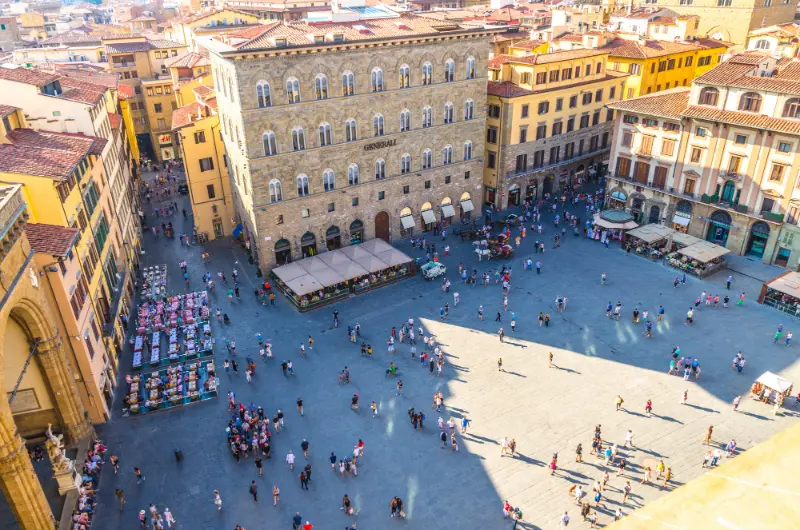
Piazza della Signoria is Florence at its most theatrical. Palazzo Vecchio rises over the square like a fortress, while the Loggia dei Lanzi works almost like an open-air sculpture gallery. Even before entering a museum, you are surrounded by copies and originals that tell the story of the city’s civic pride.
The Uffizi Gallery is next door and deserves more than a hurried visit. Botticelli, Leonardo, Raphael, Michelangelo and Caravaggio are the famous names, but the real pleasure is seeing how painting changes from room to room. If museums tire you, plan the Uffizi for the first part of the day and give yourself permission to leave after the sections that interest you most. Two focused hours are often more memorable than four exhausted ones.
Cross Ponte Vecchio and explore the Oltrarno
Ponte Vecchio has stood in its present form since the 14th century and has been associated with goldsmiths since the late 1500s. Cross it early in the morning if you want to notice the bridge itself rather than only the crowd. Then continue into the Oltrarno, the district on the “other side” of the Arno.

This is where Florence begins to feel more lived-in. Around Piazza Santo Spirito you find workshops, small bars and streets that are much calmer than those around the Duomo. The Basilica of Santo Spirito has a restrained façade but a remarkable Renaissance interior. A few minutes away, Piazza della Passera is tiny and easy to miss, yet it is a pleasant place to stop for coffee or an aperitivo.
From here you can continue to Palazzo Pitti and the Boboli Gardens. The palace speaks clearly of Medici power; the gardens offer the opposite experience to the crowded centre, with long perspectives, sculptures and elevated views over terracotta roofs.
See Michelangelo’s David, then look beyond it
The Accademia Gallery is famous above all for Michelangelo’s David, and the sculpture justifies the visit. Seeing it in person makes its scale and physical tension much clearer than any photograph. Try, however, not to leave immediately afterwards. Michelangelo’s unfinished “Prisoners” are among the most fascinating works in the museum because they seem to emerge from the stone rather than simply sit on it.
Nearby, the San Marco Museum is often much quieter. The former Dominican convent contains frescoes by Fra Angelico in the monks’ cells. It is a completely different experience from the Uffizi: restrained, peaceful and unusually atmospheric.
Give Santa Croce time for more than the façade
Santa Croce is another place where Florence’s history feels unusually personal. The basilica contains the tombs and memorials of figures including Michelangelo, Galileo and Machiavelli, while the surrounding neighbourhood mixes monumental Florence with a more everyday rhythm. Walk behind the basilica, wander toward Sant’Ambrogio and you will quickly find streets with fewer tour groups.
The Mercato di Sant’Ambrogio is a good place to see a more local side of food shopping. It is less staged than some central market experiences and fits naturally into a morning walk through this part of town.
Go to San Miniato al Monte, not only Piazzale Michelangelo
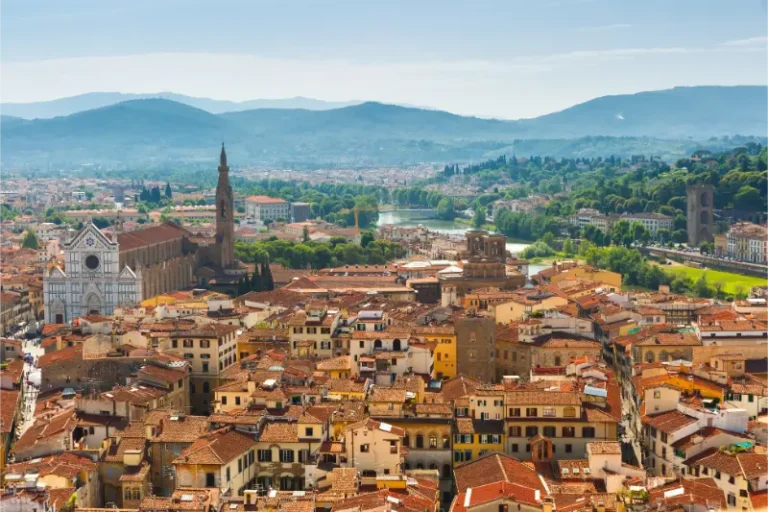
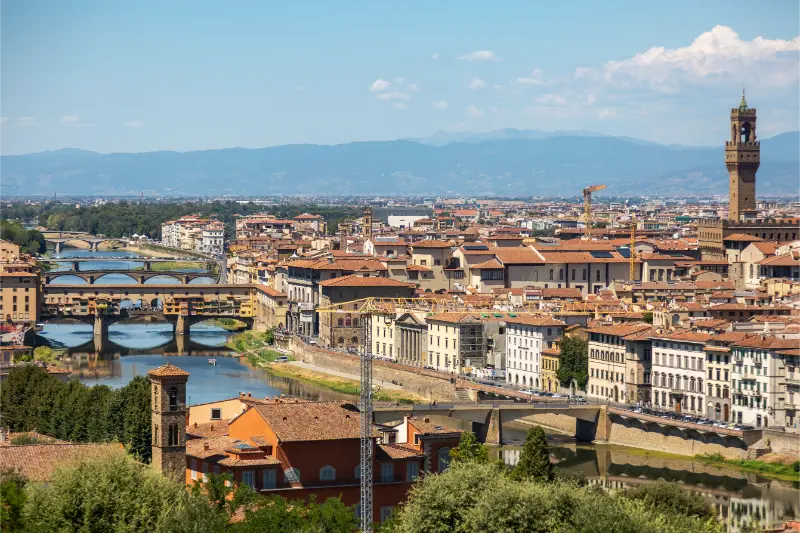
Piazzale Michelangelo delivers the classic panorama: the Duomo, Palazzo Vecchio, Santa Croce and the bridges lined up against the hills. It is especially beautiful toward sunset, but it can be busy. Continue uphill for another few minutes to the Basilica of San Miniato al Monte. The Romanesque church is one of Florence’s most beautiful, and the terrace in front has a similarly broad view with a calmer atmosphere.
If you have time, approach the hill through the Rose Garden. It creates a gentle transition from the Oltrarno to the viewpoint and feels particularly pleasant when you want a break from stone streets and museum interiors.
Useful booking tools for this trip
Tours & experiences: For guided visits, attraction tickets and bookable experiences in Florence, See tours & tickets
A small route that reveals another Florence
For a quieter hour, start near Santa Trinita, cross the river and walk through the streets between Santo Spirito and San Frediano. Look for artisan workshops rather than a specific checklist. Florence still has bookbinders, frame makers, jewellers and leather workers whose small premises are easy to pass without noticing. Continue toward Porta San Frediano and then return along the Arno. This simple loop gives you a sense of the city beyond its museum queue lines.
Where to park in Florence
Driving into the historic centre is usually more trouble than it is worth because large areas are controlled by a camera-monitored ZTL. A practical solution is to leave the car at a park-and-ride outside the centre and continue by tram. Villa Costanza, beside the A1 motorway, is especially convenient for travellers arriving by car; the tram connects it with the Santa Maria Novella area in roughly twenty minutes.
If your hotel is inside or close to the ZTL, contact the property before driving toward it. Do not assume that following a navigation app means you are authorised to enter a restricted street.
Where to eat and where to stay
In the Oltrarno, Trattoria Giovanni at Via Sant’Agostino 38/R is a strong choice for classic Tuscan cooking in a neighbourhood that still feels connected to local life. It works particularly well after a day around Santo Spirito and Palazzo Pitti.
For a small hotel with personality, 4F Boutique Hotel Florence at Lungarno Amerigo Vespucci 58 has an appealing position along the Arno, slightly away from the most crowded streets but still within walking distance of the centre. Staying on the western side of central Florence also makes evening walks along the river especially easy. Check 4F Boutique Hotel Florence prices & availability
Want more accommodation options? Where to Stay in Florence: Best Neighborhoods and Hotels for a First Visit compares the best bases and makes it easier to choose the right location before you book.
How many days do you need in Florence?
One day lets you see the Duomo area, Piazza della Signoria, Ponte Vecchio and perhaps one major museum, but it will feel fast. Two full days are much better. With three days you can add the Oltrarno, San Miniato, smaller museums and long meals without treating the city like a list of tasks.
A good first-day route is Duomo → Piazza della Signoria → Uffizi area → Ponte Vecchio → Santo Spirito → Piazzale Michelangelo. On the second day, choose the Accademia or another museum, Santa Croce, Sant’Ambrogio and the quieter streets of the Oltrarno. Florence is famous for masterpieces, but the city becomes memorable when you leave enough space between them.
Continue exploring our Tuscany destination guides to build a trip that combines Florence with smaller cities and countryside stops.
Florence in the early morning is a different city
If you are staying overnight, one of the easiest ways to improve your visit costs nothing: go out before breakfast. Walk from Piazza della Repubblica to Piazza del Duomo, then continue toward Piazza della Signoria and the river. Shop shutters are still closed, delivery traffic is limited and the main squares have enough space to notice their proportions. Ponte Vecchio is also far more enjoyable before jewellery shops open and tour groups arrive.
Another pleasant time is just after dinner. Many museum visitors have left, but the centre is still lively. A slow walk along the Arno from Ponte Santa Trinita gives one of the prettiest views of Ponte Vecchio, especially when the bridge lights reflect on the water.