
Palazzo Vecchio Florence: Tickets, Arnolfo Tower, Rooms and the Best Visiting Route
Palazzo Vecchio is one of Florence’s major attractions, but the visit is easy to misunderstand if you treat it as a single museum ticket. The civic palace in Piazza della Signoria combines the monumental rooms of the museum, the Salone dei Cinquecento, Medici apartments, the map room and, on a separate visitor route, the Torre di Arnolfo and medieval patrol walkway. The practical difference matters: the tower has shorter hours, a different ticket price and can close for weather even while the museum remains open.
For a first visit, allow at least two hours for the museum and more if you also climb the tower. Use this guide with our Florence sightseeing guide, the Uffizi guide, the Florence Duomo guide and where to stay near the Duomo.
Palazzo Vecchio at a glance
| Address | Piazza della Signoria, Florence |
|---|---|
| Museum hours in 2026 | 09:00–19:00 on Monday, Tuesday, Wednesday, Friday, Saturday and Sunday; Thursday 09:00–14:00 |
| Torre di Arnolfo hours | 09:00–17:00 on the same six days; Thursday 09:00–14:00 |
| Standard museum ticket | €18 according to the Comune di Firenze |
| Arnolfo Tower ticket | €20 standard |
| Weather rule | The tower closes in rain; the medieval patrol walkway may remain accessible |
| Best visit length | 2–3 hours for museum + tower |
Why Palazzo Vecchio deserves more than a quick look at the courtyard
Many visitors enter the first courtyard, glance at the fountain and leave because Piazza della Signoria itself feels like an open-air museum. That misses the building’s central role in Florentine political history. The palace was the seat of civic power before becoming closely tied to the Medici, and its rooms were reshaped to project authority, lineage and control. The result is not a neutral art collection: architecture, fresco cycles, maps and ceremonial space all tell a political story.
The most effective way to visit is to follow that story rather than trying to memorise every room. Start with the scale of the Salone dei Cinquecento, continue into the more intimate residential rooms and finish with the geographical imagination of the map room. The contrast between public power and private court life is what makes the palace distinctive.
The Salone dei Cinquecento: what to look for
The Hall of the Five Hundred is the visual and political centre of the museum. Its enormous dimensions make it tempting to walk in, photograph the ceiling and move on, but take time to read the room from bottom to top. Giorgio Vasari and his workshop created a decorative programme that celebrated Medici power and Florentine victories, while sculpture reinforces the sense that this is a civic theatre rather than simply a gallery.
Stand in more than one position. Near the entrance you understand the scale; farther along the hall you see how the ceiling, wall paintings and sculptures interact. If you are visiting other Medici sites, this is also one of the best places to understand how visual culture was used to turn government into spectacle.
The Medici apartments and the rooms people rush through
After the grandeur of the main hall, the upper rooms feel smaller and more personal. This is where a slow visit becomes rewarding. The apartments associated with Cosimo I and Eleonora di Toledo use mythology, family symbolism and dynastic references in a way that can seem decorative until you connect them to the political message downstairs.
Do not skip the Sala delle Carte Geografiche. The painted map cabinets and the famous globe show how a sixteenth-century court attempted to organise knowledge of the world. It is one of those rooms that becomes more interesting when you stop thinking of the maps as decoration and instead see them as instruments of power, curiosity and geography.
Should you climb the Torre di Arnolfo?
Yes, if you are comfortable with stairs and the weather is stable. The tower gives a different city view from Giotto’s Campanile or the dome because you are standing directly above Piazza della Signoria, with the cathedral complex framed across the rooftops. It is especially useful for understanding the medieval street pattern around the civic centre.
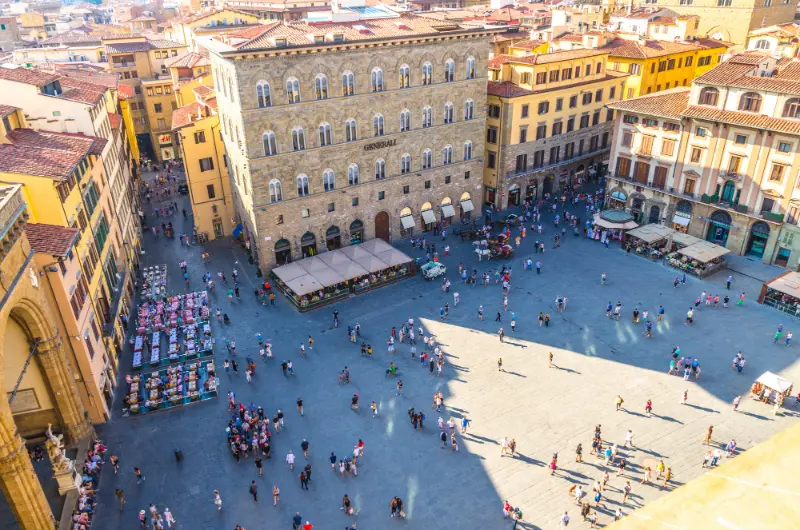
The tower route should not be treated as guaranteed. The Comune di Firenze explicitly states that it closes in rain. In that situation access may be limited to the medieval patrol walkway. If the tower is a priority, choose a dry day and do not leave it until the last hour of your final afternoon in Florence.
2026 tickets and the practical difference between museum and tower
The official Comune di Firenze page currently lists the standard museum ticket at €18 and the Arnolfo Tower ticket at €20, with reduced rates for eligible visitors. Entry to the museum is free for visitors up to age 17 under the published conditions. Ticket sales end one hour before closing, and the municipality asks visitors to arrive about 15 minutes before their booked time.
Prices and eligibility rules are exactly the kind of information that can change, so use these figures for planning rather than treating them as permanent. The official online ticket office is linked from the Comune di Firenze page.
Compare Palazzo Vecchio tickets and guided visits
Museum only or museum + tower?
Choose the museum only if you have mobility limitations, dislike steep stairways, are visiting in poor weather or already have several tower climbs in your Florence itinerary. The museum contains the essential historical material and works well as a 90-minute to two-hour visit.
Add the tower if this is your only major panoramic climb or if civic Florence interests you more than church architecture. Do not schedule the Arnolfo Tower immediately before a timed Uffizi or Accademia entry: queues, security and weather-related changes make a tight transfer unnecessarily stressful.
A sensible route through Palazzo Vecchio
- Enter from Piazza della Signoria and use the courtyard as orientation rather than your final stop.
- See the Salone dei Cinquecento before fatigue sets in.
- Move through the Medici apartments and smaller ceremonial rooms slowly.
- Spend several minutes in the map room rather than treating it as a corridor.
- Do the tower last if conditions are good; this leaves the outdoor view as the natural conclusion.
This sequence also prevents the common mistake of climbing first and then rushing the museum because you have already spent more time on the stairs than expected.
When to visit
The first opening hour is the simplest choice for a calmer visit. Late afternoon can also work, but remember that the tower closes earlier than the museum on most days. Thursday is a poor day for a relaxed combined visit because both museum and tower close at 14:00.
On very hot summer days, Palazzo Vecchio is useful in the middle of the day because much of the visit is indoors, but the tower climb itself is more comfortable in the morning. Florence weekends and public-holiday periods can be extremely busy, so book the museum if your schedule is fixed.
Palazzo Vecchio with children
The palace can work well for families because the building feels like a real fortress-palace rather than a conventional painting gallery. The Salone dei Cinquecento, maps and tower provide obvious visual hooks. What matters is pacing: a complete art-historical route through every room is more likely to exhaust younger visitors than a shorter visit built around three or four memorable spaces.
Families considering the tower should check the current access rules and honestly assess the stair climb. Do not assume that a child who happily climbs a modern staircase will enjoy a long historic tower route at the same pace.
What to combine with Palazzo Vecchio
The Uffizi is immediately nearby, but combining both major museums back-to-back can create visual fatigue. A better pattern is Palazzo Vecchio in the morning, lunch, then an outdoor walk across Ponte Vecchio or up toward Oltrarno. If you do pair it with the Uffizi, leave a real break between timed entries.

The Loggia dei Lanzi and Piazza della Signoria cost nothing and should be treated as part of the visit. Walk around the square after the museum and look again at the building façade; interior context makes the civic architecture outside much easier to read.
Check accommodation in central Florence
Bottom line
Palazzo Vecchio is worth prioritising because it explains Florence as a political city, not just an artistic one. The best visit is not the one that covers every room: it is the one that connects the Salone dei Cinquecento, the Medici apartments, the map room and, when weather allows, the Arnolfo Tower into one coherent story of power, representation and urban identity.
Practical information was checked on 11 September 2026. Opening hours, prices, temporary restrictions and access rules can change, so recheck the official source shortly before travelling.
Common planning mistakes
The most common mistake is putting Palazzo Vecchio between two fixed reservations because it sits geographically close to the Uffizi and Duomo. Geographic proximity does not eliminate ticket queues, security checks, tower weather rules or the simple desire to spend longer in a room than expected. Florence rewards compact walking, but not minute-by-minute museum stacking.
A second mistake is assuming every panoramic climb is interchangeable. The Arnolfo Tower, Giotto’s Campanile and Brunelleschi’s dome show different relationships between civic and religious Florence. If you only have energy for one, choose by what you want to understand rather than by height alone.