Chianti Wine Tasting: Best Villages, Wine Routes and How to Plan a Day
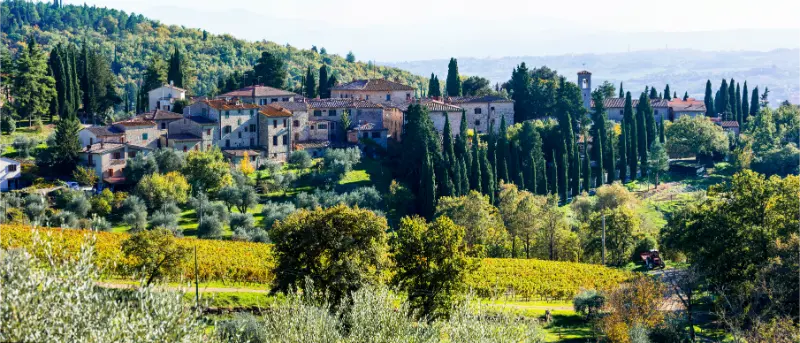
Wine tasting in Chianti is much better when you plan around the landscape rather than collecting as many wineries as possible. The core of the experience is not a tasting room in isolation: it is the sequence of vineyard roads, small villages, castles, olive groves and estates between Florence and Siena.
The practical challenge is transport. If everyone in your group wants to taste wine, a guided tour or driver is the responsible choice. If you self-drive, designate a driver who does not drink. This guide explains which villages work best, how many wineries to book, what a tasting normally involves, where the SR222 fits in, and how to build a day that still feels like Tuscany rather than a production line.
Chianti wine tasting at a glance
| Classic scenic road | SR222 Chiantigiana |
|---|---|
| Useful villages | Greve, Panzano, Castellina, Radda and Gaiole |
| Ideal winery bookings | 1–2 substantial tastings in one day |
| Best transport for everyone tasting | Guided tour, private driver or transfer |
| Best self-drive rule | One designated driver who does not drink |
| Best season | April–June and September–October |
Understand Chianti before choosing a winery
“Chianti” is used loosely by travellers, but the historic Chianti Classico area sits between Florence and Siena and includes well-known wine towns such as Greve, Radda, Castellina and Gaiole. If your goal is the landscape most people imagine when they say “a Chianti wine day”, this is the most logical place to start.
Our Chianti travel guide explains the broader area. For a wine-first overview across Tuscany, see Tuscany wine experiences.
The SR222 Chiantigiana: the road that connects the day
The SR222 links Florence and Siena through classic Chianti scenery. A useful sequence is Florence – Greve – Panzano – Castellina, with branches toward Radda and Gaiole. The official regional itinerary describes the route as roughly 69 km between Florence and Siena, but driving it end to end without stopping misses the point.
Choose a compact section and make two or three meaningful stops. A strong first-time day might use Greve for coffee and orientation, Panzano or the surrounding countryside for a tasting, then Radda or Castellina for a late-afternoon walk.
Greve in Chianti: best first stop
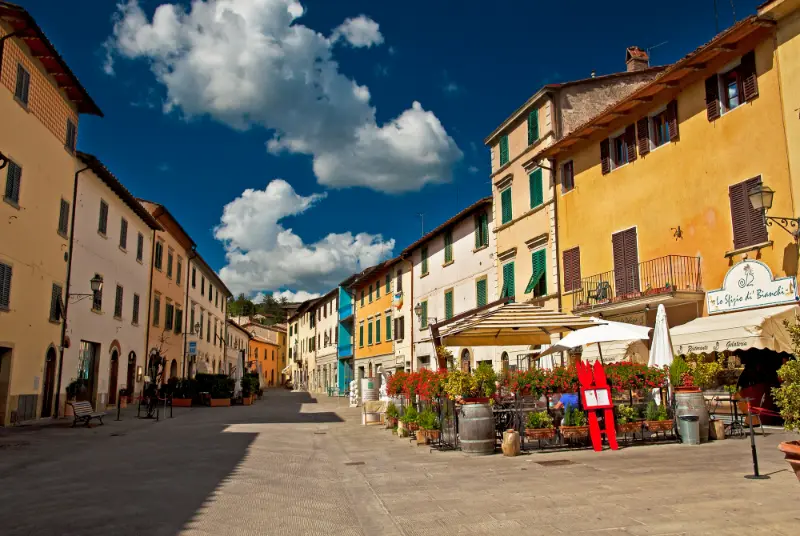
Greve is easy to understand and has enough services to make it a useful gateway. Piazza Matteotti is the heart of town, lined with arcades and shops. It is a good place to begin because you can have coffee, buy local products and reset before heading into smaller countryside roads.

Do not spend the entire wine day inside Greve. The vineyards and estates outside the town are the reason to be here.
Panzano: good for a slower middle of the day
Panzano sits between Greve and Castellina and works well for lunch. The historic upper village is small, but the surrounding countryside is dense with estates. This is an excellent area for a booked tasting followed by a meal rather than two tastings back-to-back.
Radda: best for hill-town atmosphere
Radda feels more enclosed and medieval. It is a rewarding late-afternoon stop once tastings are finished. Park outside the oldest lanes and walk into the centre. If you are staying overnight, Radda also gives you the rare luxury of enjoying Chianti after the day-trippers leave.
Castellina: good for combining wine and a historic walk
Castellina has a compact historic core and the atmospheric covered Via delle Volte. It works particularly well if one member of the group is less interested in wine: the town gives the day another layer beyond tasting rooms.
Gaiole: best for castle country
The Gaiole side of Chianti is associated with estates, castles and quieter roads. It can be a better choice for a second or third visit when you are less interested in “seeing all the famous towns” and more interested in one estate plus a long countryside lunch.
How many wineries should you book?
Two is usually enough. A serious estate visit may include vineyard or cellar context, several wines, olive oil, local food and conversation with staff. Allowing 90 minutes to two hours per stop gives you time to understand what you are tasting.
Three tastings can work if they are close together and modest, but four or five usually turns the landscape into background scenery. Leave unscheduled space for lunch and villages.
What to book: simple tasting, cellar tour or lunch
A simple tasting suits travellers who already know wine and mainly want to compare styles. A cellar tour + tasting is more useful for first-timers because it explains production and ageing. A wine lunch can be the best-value experience of the day because food gives the wines context and forces the pace to slow down.
Always book popular estates in advance during spring, summer and harvest season. Do not assume every winery accepts spontaneous visitors.
Chianti Classico labels: a simple way to read what you are tasting
Without turning the day into an exam, it helps to recognise a few terms. Chianti Classico identifies wine from the historic Classico zone. You may also encounter Riserva and Gran Selezione, which indicate different production and ageing requirements. Ask the producer to explain how their wines differ; the comparison is more useful than memorising technical rules beforehand.
The transport decision: do not leave it until the tasting room
If everyone wants to taste, book transport. A guided Chianti tour is often the simplest solution from Florence because it removes parking, navigation and the question of who has to stay sober.
See Chianti wine tours & tastings
If you self-drive because Chianti is part of a longer road trip, choose a designated driver who does not drink. Rental-car flexibility is excellent for villages and viewpoints, but it should never be used as an excuse to combine driving and wine.
A realistic self-drive day for a designated driver
09:00: leave Florence before traffic builds.
10:00: Greve and Piazza Matteotti.
11:15: first pre-booked estate visit near Greve/Panzano.
13:00: long lunch.
15:30: Radda or Castellina.
17:00: optional second estate only if the designated driver is not drinking and the schedule remains relaxed.
For a longer route, our 3-day Chianti itinerary is a better framework than cramming the whole region into one day.
Where to stay for a wine-focused Chianti trip
Stay in Greve/Panzano for straightforward access from Florence, Radda for atmosphere, or the countryside around Gaiole/Castellina for estate-style stays. Sleeping inside Chianti transforms the experience because you can book dinner and local tastings without a long return drive to Florence.
See our Where to Stay in Chianti guide for base-by-base advice.
Check Chianti stays & availability
Best time of year for wine tasting in Chianti
April to June: green landscapes and long days without peak harvest pressure.
July and August: beautiful but hot; book early and avoid overloading the afternoon.
September and October: harvest atmosphere and superb light, but this is a working agricultural period, so availability may be tighter.
Winter: quieter and more intimate, though some rural operations reduce opening days.
Food to look for between tastings
Wine makes more sense beside Tuscan food. Look for crostini, pecorino, cured meats, ribollita, pappa al pomodoro and grilled meats depending on the season. Olive oil is equally important to the landscape; many estates produce both wine and extra-virgin olive oil.
For a broader food cluster, read best food experiences in Tuscany.
Common Chianti mistakes
- Booking too many wineries and leaving no time for the villages.
- Assuming every estate allows walk-ins.
- Driving after tasting wine.
- Trying to cover Greve, Panzano, Radda, Gaiole, Castellina and Siena in a single relaxed day.
- Following a GPS blindly onto tiny rural roads when the main scenic route is easier.
- Eating a rushed sandwich when a long lunch is one of the best parts of the experience.
Is a Chianti wine tour worth it?
For travellers based in Florence who want everyone to taste, yes. The value is not only the wine; it is the removal of transport stress. For travellers already sleeping in Chianti with a sober designated driver, independent visits offer more freedom. Choose the transport style first, then build the tastings around it.
How to contact wineries: the questions worth asking
When booking, ask for the start time, approximate duration, number of wines, whether food is included, language of the tour and cancellation terms. If you are travelling with children or a non-drinker, ask whether the estate welcomes them and whether there is a non-alcoholic option. If mobility is limited, ask about stairs and uneven cellar floors before arrival.
Buying and shipping wine
If you find a bottle you love, ask the estate about shipping rules and costs to your country rather than assuming you can put several bottles into hand luggage. EU and non-EU customs limits differ. For a road trip, protect bottles from heat: a parked car in Tuscan summer sun is a poor wine cellar.
Chianti with children
A family wine-country day can work if wine is only one component. Choose an estate that explicitly welcomes families, make one tasting rather than three, and add a village, lunch and open countryside. Children should never be left to roam production areas unsupervised; wineries are working agricultural businesses.
- (‘chianti-travel-guide’, ‘Explore the Chianti area’)
- (‘tuscany-wine-experiences’, ‘Compare Tuscany’s wine regions’)
- (‘3-days-chianti-itinerary’, ‘Follow a 3-day Chianti itinerary’)
- (‘where-to-stay-in-chianti’, ‘Choose your Chianti base’)
- (‘best-food-experiences-in-tuscany’, ‘Add Tuscany’s best food experiences’)