Tuscany in October: Foliage, Chestnuts, Truffles, Wine & Weather
October is when Tuscany becomes an autumn destination rather than a quieter version of summer. Forests start to matter as much as vineyards, chestnuts become an event theme, thermal water feels timely and food tourism gains a seasonal logic. The month is also transitional: early October can still support pleasant outdoor lunches, while late October brings shorter days and a much greater chance that rain changes the plan.
Visit Tuscany says the strongest forest colours are often in the last two weeks of October and the first two weeks of November. That is a useful planning window, not a guarantee—temperature, rainfall, altitude and tree species affect colour. The official tourism site also calls October the month of the chestnut harvest and highlights long-running celebrations such as Marradi’s festival on Sundays in October.
The best October itinerary combines one forest/food region with one art or wine base. Do not spend the entire holiday driving between “autumn spots”; a wet afternoon in Siena or Florence can be as valuable as a clear morning in Casentino.
Tuscany at this time: the quick planning picture
| Period | October |
|---|---|
| Weather reality | True shoulder-season variability: warm sun, cool nights and rain can all occur. |
| Best for | foliage, chestnuts, wine, truffles, spas, villages |
| Watch out for | shorter daylight and wet rural roads need realistic timing |
A seasonal guide should change your route, not just your packing list. Decide what the season makes unusually good, what becomes harder, and what can be moved to a different time of day. That simple framework prevents the most common Tuscany planning problem: copying a generic seven-day itinerary and expecting it to work identically in every month.
Where to go and why these places work now
Casentino for foliage
Casentino is the clearest choice for a forest-led October trip. Use Poppi, Camaldoli or a nearby base and plan walks around daylight and actual trail conditions. The forests are large, so “going to see foliage” without choosing a route or village is not enough. La Verna can add a cultural stop and shelter if weather becomes unsettled.
Practical approach: give this area enough time to function as a place rather than a drive-through stop. Check opening days, parking or transport before departure, and keep one nearby alternative in mind if weather or a local event changes the plan.
Marradi and Mugello for chestnuts
Marradi celebrates its Marron Buono tradition on Sundays in October, with the historic centre filled with chestnut-based food and local products. Festival Sundays are intentionally busy. If you value a quiet town walk more than the event, choose another day; if you want the festival, research train options and special services rather than assuming easy central parking.
Practical approach: give this area enough time to function as a place rather than a drive-through stop. Check opening days, parking or transport before departure, and keep one nearby alternative in mind if weather or a local event changes the plan.
Chianti and late harvest atmosphere
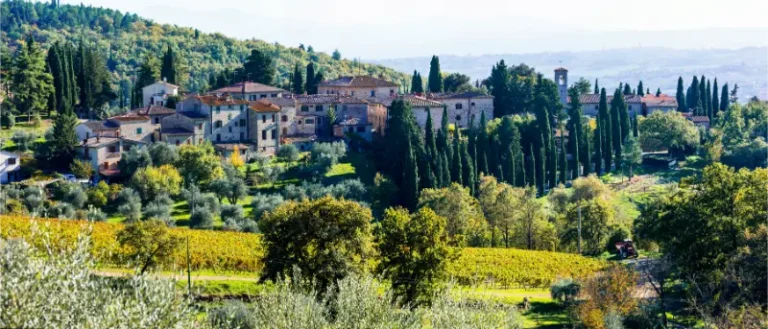
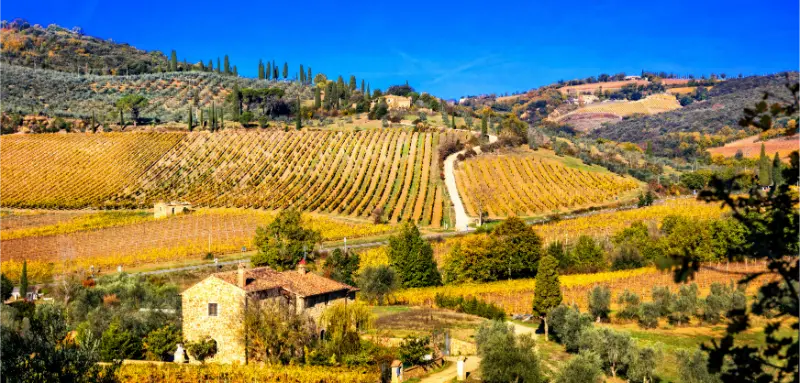
October can still overlap with harvest activity, especially depending on grape variety and year, but it is not correct to promise active picking at every winery. Vineyards turn colour and cellar visits become more autumnal. Book producers directly, ask what is happening that week and combine wine with villages rather than treating the landscape as a backdrop between tastings.
Practical approach: give this area enough time to function as a place rather than a drive-through stop. Check opening days, parking or transport before departure, and keep one nearby alternative in mind if weather or a local event changes the plan.
Val d’Orcia and thermal stops
Val d’Orcia is well suited to October because Pienza, Montalcino and San Quirico remain rewarding even when the weather changes. Bagno Vignoni and other thermal options give the region a built-in Plan B. Early darkness means you should finish panoramic driving earlier than in summer and avoid unfamiliar narrow roads after a long dinner if possible.

Practical approach: give this area enough time to function as a place rather than a drive-through stop. Check opening days, parking or transport before departure, and keep one nearby alternative in mind if weather or a local event changes the plan.
Events and seasonal timing
October’s event calendar is heavily food-led. Marradi’s chestnut celebration traditionally occupies Sundays throughout the month, and chestnut festivals also occur in the Amiata area and around Caprese Michelangelo. Truffle season begins to shape menus and later-autumn event calendars. Verify dates and ticket/transport arrangements each year.
Event information is one of the fastest-changing parts of a travel guide. Dates that are traditional can still have different hours, access rules or ticket systems each year. When an event is essential to the trip, confirm it on the organiser or municipal website shortly before buying non-refundable transport. When it is only a bonus, keep the surrounding day flexible enough that the trip remains worthwhile if the programme changes.
A realistic five-day structure
This is not a race itinerary. It shows how to alternate high-energy sightseeing with slower countryside, food or nature time so the season works in your favour.
- Day 1: Florence/Siena museum and food day. Keep the evening close to your overnight base rather than adding a second cross-region transfer.
- Day 2: Chianti villages and a booked winery. Keep the evening close to your overnight base rather than adding a second cross-region transfer.
- Day 3: Casentino foliage and Poppi/Camaldoli. Keep the evening close to your overnight base rather than adding a second cross-region transfer.
- Day 4: Marradi/Mugello if festival dates align. Keep the evening close to your overnight base rather than adding a second cross-region transfer.
- Day 5: Val d’Orcia plus Bagno Vignoni thermal stop. Keep the evening close to your overnight base rather than adding a second cross-region transfer.
If you have only three days, remove two whole geographic areas rather than compressing the five-day plan. If you have a week, add two nights in one place—the coast, Chianti, Val d’Orcia, Casentino or a thermal town—rather than adding two one-night stops. Tuscany usually becomes better as the transfer count falls.
Transport: train trip or road trip?
Florence, Pisa, Lucca and several larger towns work well by train, but the most photogenic rural areas are not a single rail corridor. A car becomes especially useful for the Val d’Orcia, Chianti back roads, Maremma, small thermal villages and scattered farms. If you do drive, treat historic centres as destinations to approach from outside rather than places to cross by car: ZTL restrictions, narrow streets and limited parking are normal. Travellers without a car should choose one or two strong rail bases and use organised day tours selectively instead of trying to reproduce a road trip with a chain of slow buses.
For a mixed trip, a useful compromise is to stay car-free in Florence, pick up the rental only when leaving the city, and return it before the final urban nights. This reduces parking cost and ZTL anxiety while preserving access to rural Tuscany. Train travellers should check the last practical return service, not merely the daytime frequency, especially on Sundays and holidays.
Where to stay
Where you sleep changes how much of Tuscany you can enjoy. A central Florence or Siena hotel makes early museum starts and evening walks effortless; an agriturismo gives you quiet mornings and countryside sunsets but usually assumes a car; a coastal base is better if swimming is the priority. Split stays only when they remove substantial backtracking. Changing hotels every night costs more time than a map suggests once packing, parking, check-in and luggage storage are included.
Use current availability rather than fixed prices: hotel rates, tour schedules and rental-car costs change by date.
Affiliate links: Tuscany Explorer may earn a commission at no extra cost to you.
Food and drink at this time of year
Chestnuts, mushrooms, truffles, pumpkin, honey, cheese and new-season products give October meals a clear identity. Wine remains central, but a strong October food trip should include forest and mountain products too. Markets and festivals are useful for tasting small portions; reserve a real restaurant dinner for a deeper regional meal rather than eating only from stalls.
For wine experiences, separate transport from tasting. Either appoint a non-drinking driver, stay within walking/taxi reach of the producer where feasible, or book a tour. For seasonal foods, ask what is actually local and current rather than assuming every menu item advertised as Tuscan is tied to that month. Markets are excellent for seeing what is in season, while producer visits are best when booked directly and given enough time.
What to book in advance—and what to leave flexible
The practical rule is to book the parts of the trip that are genuinely capacity-constrained, not every hour of the holiday. Timed museum entries, a special restaurant, a small-group winery visit, a ferry with a vehicle, or a hotel in a tiny hill town can sell out while ordinary sightseeing remains easy. Leave some open space for weather and energy. Tuscany rewards flexibility: a rainy countryside day can become a museum-and-food day, while a clear morning may be worth using for a panoramic drive or hike instead of following an over-packed checklist.
- Book first: scarce rural hotels, priority Florence museums, special holiday meals and small-group experiences.
- Confirm shortly before: ferries, trail access, mountain conditions, special event hours and seasonal attractions.
- Leave flexible: viewpoints, ordinary village walks, market browsing and weather-dependent countryside stops.
What to pack
Pack for the activity, not for the postcard. Comfortable shoes with reliable grip matter on stone streets, gravel drives and wet paths. A light layer is useful even in warm months for churches, evening breezes or air-conditioned trains; in shoulder seasons add a compact waterproof shell. Carry water on rural walks and sun protection from late spring into early autumn. If your trip includes spas, beaches or pools, bring a swimsuit and a small quick-dry layer rather than assuming every property supplies everything you need.
A small day bag should hold water, a charged phone/power bank, any timed-entry confirmations and a layer you can actually carry when not wearing it. If you are driving rural roads, keep the car supplied but do not leave visible luggage at scenic pull-offs. For churches, shoulders and knees should be covered appropriately; a light layer often solves both etiquette and temperature changes.
Travelling with children
Families generally do better with one major objective per half-day. Pair a museum with a garden, a hill town with a farm lunch, or a beach morning with a short old-town walk. Medieval centres often involve slopes, cobbles and steps, so a lightweight stroller or child carrier can be more practical than a large pushchair. Build in playground, gelato and open-space stops. In hot weather, protect the middle of the day; in colder months, alternate outdoor sightseeing with a warm indoor stop.
Choose experiences with a clear duration. A two-hour farm visit, short boat trip or compact museum is easier to integrate than an undefined all-day excursion. Check minimum ages, height rules and child-seat arrangements directly with activity providers. On driving days, a playground or open square can be a deliberate stop rather than an emergency afterthought.
Common planning mistakes
- Expecting peak foliage everywhere on October 1
- Planning a forest walk that ends after dark
- Assuming festival parking will be simple
- Promising yourself a grape-picking experience without producer confirmation
- Packing only aesthetic autumn clothes and no waterproof layer
The underlying mistake is trying to maximise the number of famous names instead of maximising the quality of each day. Tuscany’s map encourages over-planning because distances can look short. Rural roads, parking, ZTL edges, meals and hotel check-ins make real travel slower. Seasonal conditions magnify that difference, so build margin into every day.
Frequently asked questions
Do I need a car?
Not for Florence, Pisa or Lucca, and not necessarily for a city-focused trip. A car becomes much more useful for Val d’Orcia, Chianti, Maremma, farms and small villages.
How far ahead should I book?
Book high-demand museums, special restaurants, small-group experiences and scarce rural stays first. Ordinary local transport and flexible sightseeing usually need less advance commitment.
Is Tuscany good for a short trip?
Yes, if you choose one city plus one nearby rural zone instead of crossing the whole region. Three focused days usually feel better than three days of constant transfers.
Can I visit without speaking Italian?
Yes in the main tourist areas. Learning a few polite Italian phrases still helps in small villages, markets and family-run businesses.
Is Tuscany in October a good idea?
Yes, when the itinerary is built around the strengths and limitations described in this guide. It is not automatically better or worse than another season; it suits a different mix of activities.
Should I change hotels every night?
Usually no. Two- or three-night bases make it easier to respond to weather, events and opening days while reducing time lost to luggage and check-in.
Sources checked for this guide
Seasonal details in this article were checked against official destination, municipal or event sources. Prices, hours and individual event programmes can change after publication, so re-check the source that matters for your exact travel date.
- https://www.visittuscany.com/en/ideas/the-best-landscapes-for-your-autumn-in-tuscany/
- https://www.visittuscany.com/en/ideas/chestnut-fever-chestnut-festivals-in-tuscany/
- https://www.visittuscany.com/en/autumn/
Final planning checklist
- Choose the two experiences that would genuinely disappoint you to miss and reserve those first; do not pre-book every meal and viewpoint.
- Check the weather again 48–72 hours before rural, coastal or mountain days and be willing to swap days within the itinerary.
- Verify ZTL and parking strategy for every overnight city if you have a car; a hotel address inside the walls does not mean you may legally drive to its door.
- Save offline maps for countryside days and screenshot booking confirmations in case mobile coverage is weak inside stone buildings or rural valleys.
- Check restaurant closing days in small towns. A beautiful village with three excellent restaurants can still be a poor dinner plan if all three take the same weekly day off.
- Keep one low-effort option—thermal pool, museum, market or long lunch—for the day when weather or travel fatigue changes the plan.
- If you are using trains, check the specific service number and last return connection for Sundays or holidays rather than assuming the weekday pattern applies.
- For winery, farm and artisan visits, arrive on time. These are working businesses and small-group experiences, not attractions with continuous entry.
- Re-check seasonal event details shortly before departure. The article records verified planning information, but organisers can change hours or access rules.
- Protect unstructured time. A free late afternoon in Pienza, Lucca or Florence often becomes the part of the trip people remember most.