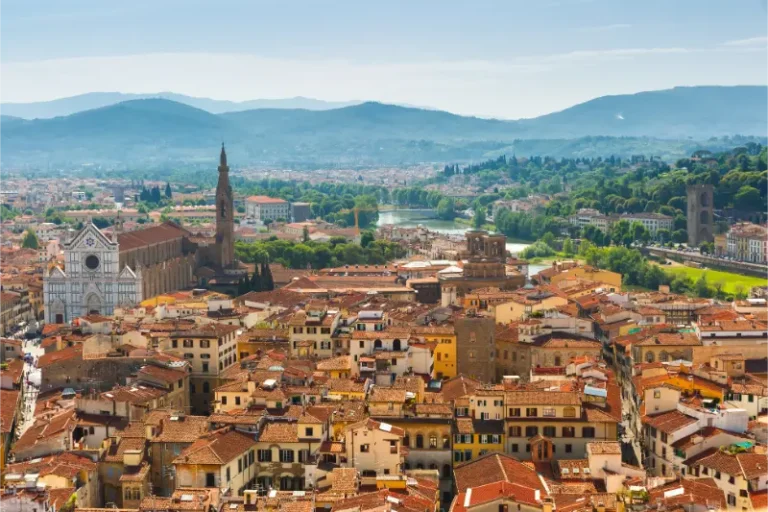

Public Transport in Tuscany: Trains, Buses, Trams, Tickets and Easy Connections
Public transport in Tuscany is strong enough to build an excellent car-free holiday, provided you match the itinerary to the network. Regional trains are the backbone for cities and larger towns. Autolinee Toscane buses fill many of the gaps, including connections to hill towns. Florence has a useful tram system, ferries link the mainland with Tuscan islands, and taxis solve the occasional final kilometre. The system becomes frustrating only when visitors expect a rural village to have the same frequency as Florence.
Think of Tuscany as a network of layers
The easiest way to understand transport is to think in layers. Trains cover the main corridors. Buses connect stations, suburbs, hill towns and villages. Trams handle selected urban routes in Florence. Ferries extend the network to islands. Taxis or transfers are the flexible final layer when a timetable does not fit.
This makes city-to-city travel straightforward but means a rural trip may involve two modes. A journey to San Gimignano, for example, is naturally a train-plus-bus trip because the town has no station.
The official regional tourism overview for getting around Tuscany is a useful starting point before you build specific days.
Regional trains: the backbone
Florence is the principal rail hub, with regional lines towards Pisa, Lucca, Livorno, Pistoia, Prato, Arezzo, Cortona and other destinations. Pisa is another very useful node for western Tuscany and connections to its airport.
Trains are generally the best public-transport choice when both places have convenient stations. They avoid road traffic, make luggage easier than many bus journeys and allow you to move between cities without thinking about ZTLs or parking.
For a route-by-route explanation, see our Tuscany by train guide. Check live schedules on Trenitalia Toscana.
Autolinee Toscane buses
Regional and local bus services are operated through Autolinee Toscane. The official at-bus.it website and at bus app provide journey planning, service information and ticket options.
Buses matter most when the railway stops short of the historic centre. They are essential for many hill towns and useful within cities such as Siena. Route frequency can vary by day, school period and season, so always look at the return journey as well as the outbound bus.
If a trip depends on the final bus of the evening, screenshot or save the relevant timetable before leaving Wi-Fi. A beautiful sunset is less relaxing when you are unsure whether the last connection has already gone.
Contactless payment and the at bus app
Autolinee Toscane supports contactless “Tip Tap” payment on equipped buses and trams. On urban services the system generally requires a tap when boarding; on extra-urban and mixed/fast services, the correct procedure includes tapping when boarding and leaving. Current instructions should always be checked in the official app or website because payment systems can evolve.
Use the same card or device consistently for the journey. If several people travel together, the app may be more practical because a single contactless card cannot necessarily be used as a simple group ticket in every situation.
The app is also valuable for checking disruptions and planning connections. Download it before the trip rather than trying to learn it while a bus is approaching.
Florence tram: particularly useful for the airport
Florence’s tram network is simple compared with a large metro system but extremely useful for selected journeys. The T2 line connects Florence Airport with the city area near Santa Maria Novella, making it an easy arrival option for visitors.
Trams also help travellers staying outside the tight historic centre or using park-and-ride strategies. Once in central Florence, most major sights are better reached on foot.
Do not expect the tram to replace all buses or walking. Think of it as a fast urban corridor that complements the rest of the system.
Siena and hill-town buses
Siena demonstrates why buses matter in Tuscany. Its railway station sits below the historic centre, while bus services can connect different parts of the city and surrounding towns. Depending on your origin, a bus from Florence can even be more convenient than rail for central Siena.
Hill towns often require checking the stop name carefully. The town name alone may correspond to several stops, and the bus station may be on the edge of the pedestrian centre.
Ask your accommodation which stop is most useful if you are staying overnight. A five-minute local recommendation can prevent getting off one valley too early.
Train-plus-bus connections
Some of Tuscany’s best-known destinations naturally use combined transport. San Gimignano is commonly reached via Poggibonsi followed by bus. Cortona requires a connection up from the rail stations at Camucia-Cortona or Terontola-Cortona. Montepulciano and other hill towns also rely on bus links from rail gateways.
Trenitalia promotes integrated “Link” products for selected destinations, combining train and bus. These can simplify planning, but check the current route and ticket conditions for your date.
When connecting independently, leave more time than the mathematical minimum. Regional transport is much more enjoyable when a ten-minute delay does not destroy the entire day.
Ferries as part of public transport
Tuscany’s transport network continues across the water. Piombino is the main departure point for Elba, with ferry services to island ports. Livorno and Porto Santo Stefano also serve island routes depending on destination and operator.
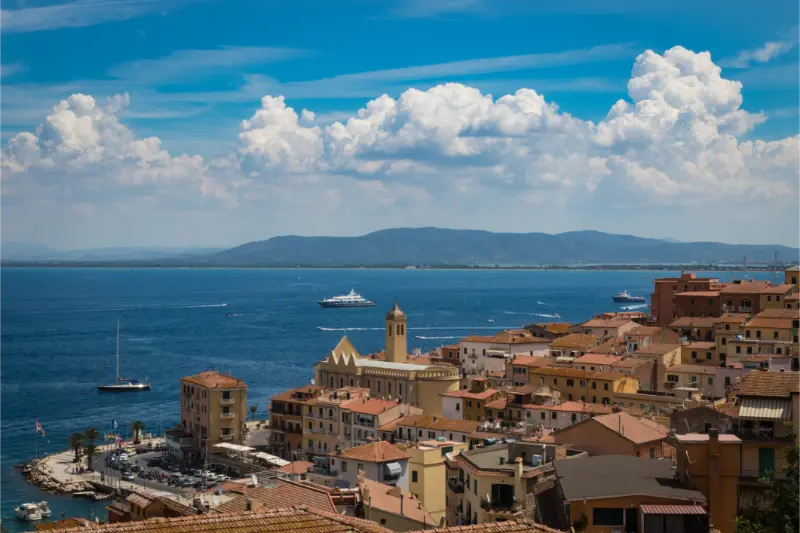
Travellers without a car can combine train, bus and ferry, especially for Elba. Check whether the railway timetable uses Piombino Marittima or a connecting service on your date, and confirm ferry departure terminals because large ports can involve walking or shuttle distances.
If Elba is part of your plan, see our Elba Island guide before choosing the mainland base.
Useful booking tools for this trip
Trains & buses: Compare trains & buses when building the transport part of the trip.
Taxis and private transfers
Taxis are useful for the gaps that public transport does not fill elegantly: a late arrival, a countryside hotel several kilometres from a bus stop, or the final climb to a hill town with luggage. Official taxis in Italy are typically white and use designated ranks or telephone/app booking systems depending on the city.
In rural Tuscany, do not assume you can hail a taxi on an empty road. Book ahead if the journey is important. A private driver can also make sense for a wine day where nobody wants to drive.
Using one taxi strategically does not make a car-free trip a failure. It can be cheaper and easier than renting a vehicle for an entire week just to solve two awkward transfers.
Night services, Sundays and holidays
Transport frequency is not uniform across the week. Urban corridors may run late, while rural routes can become sparse in the evening. Sundays and public holidays can reduce bus frequency, and seasonal services may operate only during parts of the year.
Build important excursions around the timetable rather than assuming you can always return after dinner. If you want a late evening in a small village, consider sleeping there instead of racing for the last bus.
Before a flight or long-distance train, use an earlier connection than strictly necessary. The cost of an extra coffee near the station is small compared with missing an international departure.
Accessibility and travelling with children
Modern trains, trams and many buses provide accessibility features, but historic stations and rural stops vary. Travellers with reduced mobility should check assistance arrangements and accessible routes in advance, especially where a hill-town connection involves steep streets after the stop.
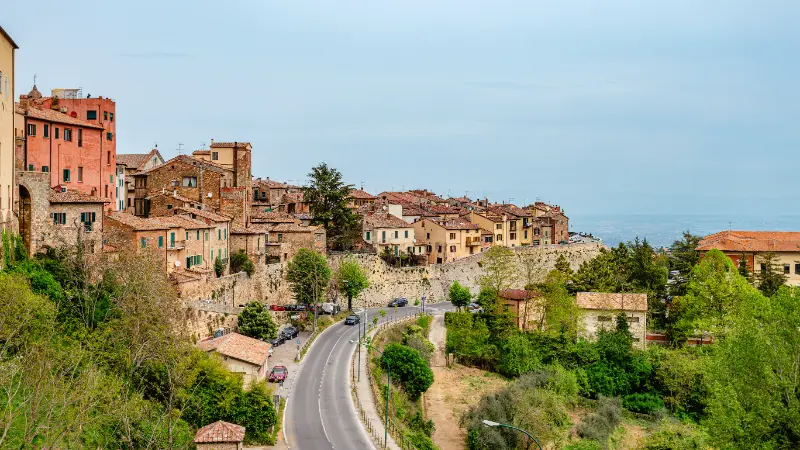
With children, minimise changes. A direct bus that takes slightly longer can be easier than train + change + local bus. Keep snacks, water and a small activity within reach rather than buried in luggage.
Pushchairs are much easier in Florence and Pisa than on steep medieval streets. Public transport may get you to the town, but the town itself can still involve cobbles and gradients.
A realistic public-transport itinerary
A week without a car could begin with Florence, continue by train to Lucca and Pisa, then move to Siena by the connection that best suits your date. Add one hill town using a bus rather than trying to collect five. Another itinerary could use Florence as a base for Arezzo and Pisa day trips, then move to the coast.
The key is not to imitate a driving itinerary. Public transport has its own strengths: central arrivals, no parking, no ZTL stress and the ability for everyone to relax.
For a complete planning model, read our Tuscany without a car guide
Build in a small connection buffer
Tuscany’s public transport is much easier when every change is not treated as an exact-minute challenge. For a train-to-bus connection in a hill-town itinerary, a little waiting time can be useful: it gives you time to find the correct stop, buy or activate the right ticket and recover from a delayed train. If the connection is the last service of the day, choose an earlier train whenever possible. The aim is not to create the fastest theoretical route but the route most likely to work calmly in real life.
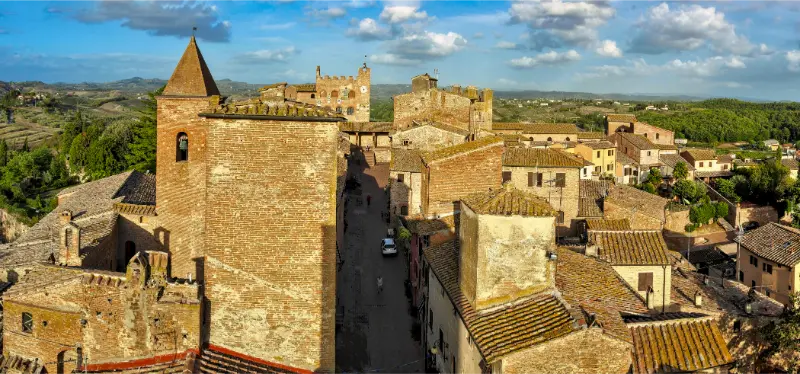
Where to stay for this trip: Where to Stay in Tuscany Without a Car: Best Bases for Trains and Easy Day Trips. Check prices & availability
Final thoughts
Public transport in Tuscany works best when you respect the geography of the network. Use trains for the strong corridors, buses for hill towns, trams for useful urban links and taxis for occasional gaps. Check the last connection, keep official apps on your phone and avoid building days with four fragile changes. With that approach, a car-free Tuscany can be not only possible but genuinely relaxing.