What to See in Lucca: Walls, Towers and the Quiet Charm of Tuscany
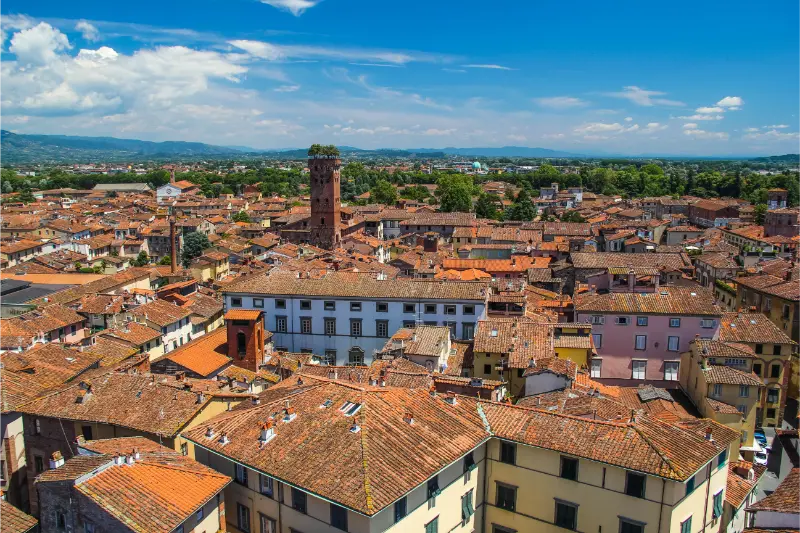
Lucca has a rare quality among famous Tuscan cities: it is beautiful without constantly demanding your attention. There is no single monument that overwhelms everything else. Instead, the city reveals itself through its intact walls, quiet lanes, church façades, small piazzas and towers rising above terracotta roofs.
Protected for centuries by a formidable ring of Renaissance fortifications, Lucca preserved a strong sense of independence and a compact urban fabric. Today those defensive walls have become one of Italy’s most enjoyable elevated promenades. They are the perfect introduction to a city that rewards slow exploration rather than frantic sightseeing.
Walk or cycle the city walls first
Lucca’s walls stretch for about 4.2 kilometres and were built largely between the 16th and 17th centuries. They were never seriously tested in battle, which is fortunate because their preservation is exceptional. The top of the walls is now a broad, tree-lined route used for walking, cycling and everyday exercise.
Make this your first experience of Lucca. From the walls you see bell towers, gardens and rooftops, while gates and bastions help you understand the shape of the historic centre. Renting a bicycle is popular, but walking is just as rewarding and lets you stop whenever a view or shaded bench catches your attention.
Enter Piazza dell’Anfiteatro from a narrow arch
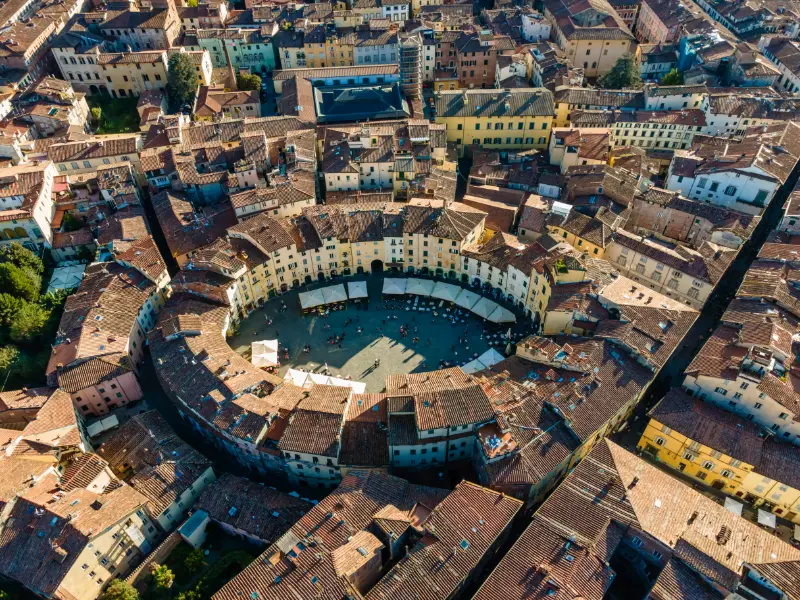
Piazza dell’Anfiteatro is one of Lucca’s most distinctive spaces. Its oval shape follows the footprint of a Roman amphitheatre, although the buildings you see today are much later. The best way to experience it is not by looking for a wide ceremonial entrance but by approaching through one of the narrow passages from the surrounding streets. The piazza suddenly opens around you, which makes its geometry much more dramatic.
It is a good place for an early coffee, but for lunch or dinner you may find better value a few streets away from the most photographed tables.
Climb Guinigi Tower through a rooftop garden
The Torre Guinigi is instantly recognisable because mature holm oaks grow on its rooftop. The climb passes through a medieval tower house before opening onto a small garden high above the city. From there, Lucca’s churches and red roofs spread toward the Apuan Alps.
If you enjoy viewpoints, also consider the Torre delle Ore. It has a different character and a historic clock mechanism, while the view toward Guinigi Tower can be especially photogenic. You do not need to climb both unless towers are a particular interest; choose one and save your legs for walking the walls.
Visit San Martino and look for details
Lucca Cathedral, dedicated to San Martino, has a beautifully layered Romanesque façade and an interior with works connected to some of the city’s most important traditions. The famous Volto Santo has made Lucca a pilgrimage destination for centuries, while the tomb of Ilaria del Carretto by Jacopo della Quercia is one of the most graceful sculptures of the early Renaissance.
Outside, notice that the arches and columns of the façade are not perfectly uniform. Lucca’s beauty often lies in this kind of variation rather than monumental symmetry.
Stop in Piazza San Michele
San Michele in Foro occupies the site of Lucca’s Roman forum. Its façade rises in multiple tiers of delicate arcades and seems almost too elaborate for the relatively compact square around it. The church is one of the clearest reminders that medieval Lucca was a prosperous trading city with strong connections across Europe.
From Piazza San Michele, wander without a strict route through Via Fillungo and the smaller parallel lanes. This is the heart of Lucca’s everyday centre, with shops, bakeries and historic storefronts mixed among palaces and churches.
Find Puccini’s Lucca
Composer Giacomo Puccini was born in Lucca, and his birthplace is now a small museum near Piazza Cittadella. Even if you are not an opera enthusiast, the scale of the house is interesting because it connects an internationally famous figure with a very ordinary urban setting.
In the evening, check whether there is a concert or recital in the centre. Music feels especially appropriate in Lucca because it is woven into the city’s identity rather than presented only as a tourist attraction.
Look into Palazzo Pfanner’s garden
Palazzo Pfanner offers one of Lucca’s loveliest combinations of architecture and garden. Its formal space, with statues and a view toward the walls, provides a quieter alternative to the city’s major piazzas. The palace is also connected with Lucca’s brewing history, adding an unexpected detail to the visit.
Another pleasant escape is the Botanical Garden near the walls. It is small enough to visit without turning the day into a major excursion and works well when you want greenery after several churches.
Where to park in Lucca
The historic centre is largely restricted to authorised traffic, so parking outside the walls is the simplest choice. Piazzale Don Baroni, the Tagliate area and Macelli are among the options used by visitors. From there, enter through one of the city gates and continue on foot.
Lucca is also very convenient by train: the station is only a short walk from the walls and Porta San Pietro. If you are travelling between Florence, Pisa and Lucca, arriving by rail can remove the parking question altogether.
Where to eat and where to stay
Buca di Sant’Antonio, at Via della Cervia 3, is one of Lucca’s classic restaurants and occupies a setting full of character. It is a good address for traditional Tuscan and Lucchese flavours when you want dinner to feel like part of the city experience.
For a stay inside the walls, Hotel Palazzo Alexander at Via Santa Giustina 48 combines a central position with the atmosphere of a historic building. Staying within the walls is especially enjoyable in Lucca because early mornings and evenings are wonderfully quiet. Check Hotel Palazzo Alexander prices & availability
Useful booking tools for this trip
Tours & experiences: For guided visits, attraction tickets and bookable experiences in Lucca, See tours & tickets
How long should you stay in Lucca?
Lucca is easy to see in one full day, but it is also one of the Tuscan cities where an overnight stay adds disproportionate value. Day visitors thin out, bicycles continue around the walls and the centre takes on a relaxed evening rhythm.
For a first visit, walk the walls in the morning, enter Piazza dell’Anfiteatro, climb Guinigi Tower, visit San Martino and San Michele, then finish around Piazza Cittadella or with another section of the walls at sunset. The city does not need to be “completed.” Its appeal is precisely that there is always another lane, courtyard or church to discover at walking pace.
See more ideas in our Tuscany destination guides.
Want more accommodation options? Where to Stay in Tuscany: The Best Areas for Every Kind of Trip compares the best bases and makes it easier to choose the right location before you book.
Visit Lucca in the morning market rhythm
Lucca is at its most convincing when everyday life and historic architecture overlap. Walk through the centre in the morning and you will see residents cycling across piazzas, deliveries entering side streets and cafés filling gradually rather than all at once. Because cars are restricted in much of the centre, bicycles feel like part of the city rather than a tourist activity.

If you rent one, use it mainly for the walls and broad streets. In the narrow centre it is often nicer to walk, especially around Via Fillungo and Piazza dell’Anfiteatro where pedestrian traffic can be dense.
Look behind the church façades
Lucca is traditionally called the “city of a hundred churches,” and you quickly understand why. You do not need to enter all of them. Pick a few contrasting examples: San Martino for the cathedral scale, San Michele for Romanesque exuberance, San Frediano for its façade mosaic and Sant’Alessandro for a quieter, more austere atmosphere.
San Frediano is especially worth adding because the large mosaic catches the light above a piazza that feels less formal than the Duomo area. From there, it is a short walk to Piazza dell’Anfiteatro.
What to eat in Lucca
Try tordelli lucchesi, filled pasta usually served with a rich meat ragù. Garmugia, a spring soup with vegetables and meat, is another local dish when in season. For something simple, buccellato is Lucca’s traditional sweet bread scented with anise and raisins; it travels well and makes an easy snack for the train or next day’s drive.
Lucca’s food is hearty, so a lighter lunch followed by a more traditional dinner is often a comfortable way to structure the day.
Choose a gate and make it part of the walk
Lucca’s gates are not just practical entrances; they help give the walls their sense of place. Porta San Pietro is convenient for the railway station, while other gates lead toward different neighbourhoods and parking areas. Enter through one gate and leave through another if you can. The short passages through the massive fortifications make the contrast between outside traffic and the pedestrian centre especially noticeable.
Once inside, resist the urge to navigate only with the shortest route. Lucca is small enough that a five-minute detour rarely causes problems and often reveals a courtyard, façade or quiet garden.
Lucca with children is unusually easy
Among Tuscany’s historic cities, Lucca is one of the least stressful for families. The walls provide open space for walking and cycling, the centre is largely flat, and distances between major sights are short. Piazza dell’Anfiteatro and Guinigi Tower also give children something visually distinctive beyond a sequence of churches.
A good family rhythm is a wall walk in the morning, one indoor sight before lunch, a relaxed break in a piazza and a bicycle ride later in the day. You can see a great deal without asking children to spend hours in museums.