What to See in Pietrasanta: Tuscany’s Open-Air Art Town Between Marble and Sea
Pietrasanta is one of the most unusual small cities in Tuscany. At first glance it has the familiar ingredients of a historic centre — a cathedral, a broad piazza, stone streets and café tables — but then you notice a monumental bronze figure, a contemporary installation beside a medieval façade or the entrance to a sculptor’s workshop. Art is not confined to a museum here. It occupies the square, the cloister, the pavement and the daily life of the town.
The connection comes from nearby Carrara marble and the long tradition of skilled artisans in this part of northern Tuscany. Over time, Pietrasanta attracted Italian and international sculptors who needed foundries, stone workshops and craftspeople capable of turning ambitious ideas into physical works. That network earned the town the nickname “Little Athens”. Today it feels elegant without becoming formal, creative without losing its Tuscan scale.
Begin in Piazza del Duomo
Piazza del Duomo is Pietrasanta’s stage. The space is broad enough for major sculptures and temporary installations, yet it remains surrounded by historic buildings that keep the atmosphere intimate. The first thing to do is resist the urge to head immediately into the cathedral. Walk around the square and see how contemporary works interact with the old façades.
The art changes over time, which means the piazza can look different on a return visit. That temporary quality is part of the experience. Pietrasanta is not preserving a single perfect historical image; it is continually adding new visual conversations to an old urban space.
Visit the Duomo di San Martino
The Duomo di San Martino anchors the main square with a marble façade that feels entirely appropriate in a town shaped by stone. The church has medieval origins and later additions, including its distinctive bell tower.
Step inside even if contemporary art is your main interest. Pietrasanta makes more sense when you see the contrast between sacred historic craftsmanship and the modern sculpture outside. Look closely at carved details rather than treating the church only as a backdrop to the piazza.
See Sant’Agostino as an exhibition space
On the same square, the former Church of Sant’Agostino and its cloister are central to Pietrasanta’s cultural identity. The complex is frequently used for exhibitions, allowing contemporary works to occupy a historic religious setting.
Check what is on during your visit. Even if you do not recognise the artist, the setting is often worth entering. The quiet architecture gives sculpture room to breathe, and the experience is usually far more relaxed than visiting a major urban gallery.
Look for Mitoraj and Botero in the town itself
Pietrasanta is strongly associated with major international artists who worked with local artisans. Works by Igor Mitoraj became especially connected with the city, and sculptures such as the Centauro and other pieces help define its public-art identity. Fernando Botero also had a close relationship with Pietrasanta, and his presence remains visible through public works and local cultural memory.
Do not turn this into a scavenger hunt where you stare at a phone between sculptures. The better approach is to walk normally and let works appear. A bronze figure at the end of a lane or a monumental form against a church wall has more impact when it feels discovered.
Walk Via Garibaldi and the smaller gallery streets
The streets around Piazza del Duomo are lined with galleries, design shops and cafés. Via Garibaldi is particularly pleasant, but explore the side lanes too. Pietrasanta is compact enough that you can follow whichever storefront or courtyard catches your attention.
Galleries here range from highly polished spaces to small rooms where the owner may be present. You do not need to be a collector to enter. Spend a few minutes looking, ask questions if the atmosphere feels welcoming and treat the galleries as part of the town rather than shops reserved for experts.
Understand the workshops behind the finished sculptures
The real secret of Pietrasanta is not only the artists’ names; it is the network of artisans who fabricate their works. Marble studios, mosaic workshops and bronze foundries in the area have collaborated with internationally known sculptors for decades.
Some are working businesses rather than visitor attractions, so do not walk into industrial spaces uninvited. When a studio offers visits or an open event, however, it can be one of the most fascinating experiences in town. Seeing moulds, tools and unfinished forms reveals how much technical expertise sits behind a sculpture that later appears effortless in a piazza.
Find the Rocchetta Arrighina and Porta a Pisa
Near the edge of the historic centre, the Rocchetta Arrighina and Porta a Pisa preserve traces of Pietrasanta’s defensive past. They are easy to pass when your attention is focused on art, but they help explain the older city beneath the contemporary identity.
Use this area as a transition toward quieter streets. Within minutes of Piazza del Duomo, the crowds thin and Pietrasanta starts to feel like a small residential Tuscan town again.
Climb toward the Rocca di Sala for the view
Above Pietrasanta, the remains of the Rocca di Sala occupy a hill with broad views toward the coast and Apuan Alps. The climb gives you a completely different perspective on the town’s location between mountains and sea.
The path and slopes require more effort than the flat historic centre, so wear suitable shoes and avoid the hottest part of a summer day. Even if you do not reach every ruin, the elevated panorama helps connect Pietrasanta with the marble landscape to the east and Versilia to the west.
Stay for the evening aperitivo
Pietrasanta becomes especially attractive in the early evening. Gallery doors remain part of the street scene, the piazza fills with people and outdoor tables create a social atmosphere that feels sophisticated without being overly formal.
If you are choosing between a rushed afternoon stop and staying for dinner, choose the latter. Public sculpture is also more dramatic after sunset, when artificial light isolates forms against the darker stone of the historic buildings.
Useful booking tools for this trip
Tours & experiences: For guided visits, attraction tickets and bookable experiences in Pietrasanta, See tours & tickets
Where to eat in Pietrasanta
Sementis, at Via Garibaldi 17, is a highly rated restaurant in the historic centre and stands out for a creative, contemporary approach. It suits Pietrasanta’s artistic character particularly well and is a good choice for travellers who want something different from a standard Tuscan trattoria.
Osteria Stappasogni, at Via XX Settembre 10, is another strongly reviewed option close to the centre. Booking is advisable on summer evenings and weekends when the town attracts visitors from the Versilia coast.
Where to stay
Albergo Pietrasanta, at Via Garibaldi 35, is an elegant hotel in the historic centre and one of the most characterful places to stay if you want to experience the town after day visitors leave. The location puts galleries, restaurants and Piazza del Duomo within a few minutes’ walk. Check Albergo Pietrasanta prices & availability
If your trip is primarily a beach holiday, Marina di Pietrasanta has a wide range of coastal accommodation. For art and evening atmosphere, however, the old town is the more distinctive base.
Want more accommodation options? Where to Stay in Tuscany: The Best Areas for Every Kind of Trip compares the best bases and makes it easier to choose the right location before you book.
Where to park in Pietrasanta
The historic centre is compact and largely oriented toward pedestrians, so use signed parking areas outside the core and walk in. Trying to drive as close as possible to Piazza del Duomo adds little and can lead you toward restricted streets.
Summer evenings can be busy because people come inland from the coast for dinner and exhibitions. Arrive before the main aperitivo period if you want an easier parking experience. Once parked, you can cover all the central sights comfortably on foot.
How much time do you need?
Three hours allow you to see Piazza del Duomo, the cathedral, Sant’Agostino and several galleries. A half day is better if you want to walk toward the Rocca or explore workshops. Staying through dinner is the ideal rhythm because Pietrasanta’s social and artistic atmosphere becomes more visible in the evening.
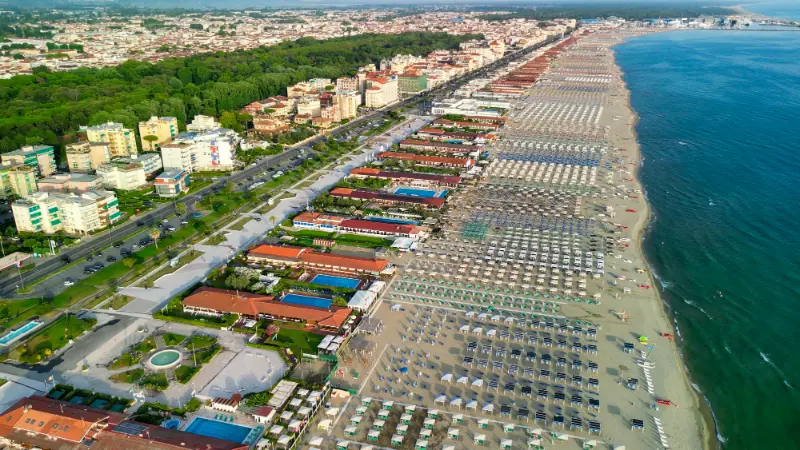
If you are based in Viareggio, our Viareggio guide helps combine the two without overplanning: beach and Liberty architecture in one city, galleries and sculpture in the other.
A simple route through Pietrasanta
Enter the centre and begin in Piazza del Duomo. Visit San Martino and Sant’Agostino, then wander Via Garibaldi and the gallery streets. Look for public works without following a rigid map, continue toward Porta a Pisa and, if the weather is comfortable, climb toward the Rocca di Sala. Return to the piazza for an aperitivo and dinner.
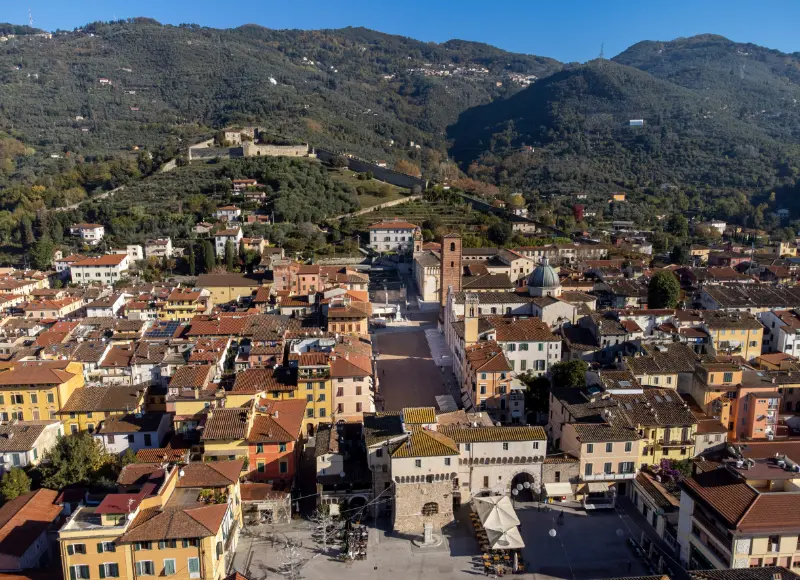
Pietrasanta does not need a long checklist. Its strongest quality is the conversation between periods: marble carved centuries ago, a contemporary bronze installed yesterday, a medieval church hosting a new exhibition. Few small Tuscan cities make art feel so normal and so alive.
Why Pietrasanta feels elegant without feeling like a museum
Many art destinations separate culture from daily life: you enter a museum, see the collection and return to ordinary streets. Pietrasanta does the opposite. Sculpture is part of where people meet, drink coffee and walk home.
That makes the town especially approachable for visitors who like art but dislike formal institutions. You can spend ten minutes with a work, sit for lunch, notice another sculpture on the way back and never feel that you are completing an assignment. The entire historic centre functions as a cultural space, but it remains a real town first.