What to See in Montepulciano: Renaissance Streets, Hidden Cellars and Huge Tuscan Views
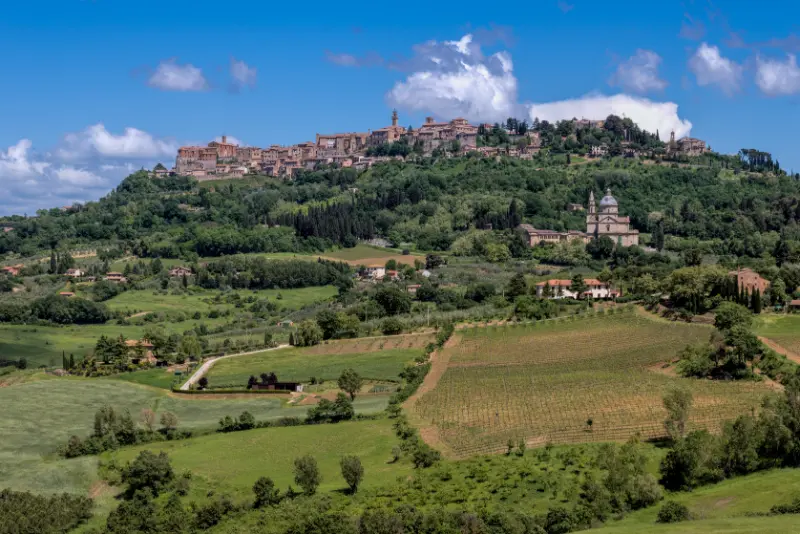
Montepulciano is a town that makes you work a little for its beauty. The historic centre stretches uphill along a ridge, so a visit is a gradual climb through Renaissance palaces, wine cellars, tiny squares and long views toward the Val d’Orcia and Val di Chiana. By the time you reach Piazza Grande at the top, you have not simply arrived at the main square; you have watched the town unfold one street at a time.
Its medieval street plan was reshaped during the Renaissance, when wealthy local families commissioned elegant palaces and architects connected to Florence and Rome gave Montepulciano a more monumental character. That mixture is what makes it distinctive. It is not a perfectly preserved medieval stage set, nor only a wine destination. It feels like a working hill town whose stone buildings happen to contain some of the most impressive Renaissance architecture in southern Tuscany.
Start at Porta al Prato and walk the town from bottom to top
Entering through Porta al Prato gives the visit a natural rhythm. From here, Via di Gracciano nel Corso and the streets that follow lead uphill through the historic centre. The slope is steady rather than extreme, but comfortable shoes matter. Instead of viewing the climb as something to get over with, use it as the structure of the day.
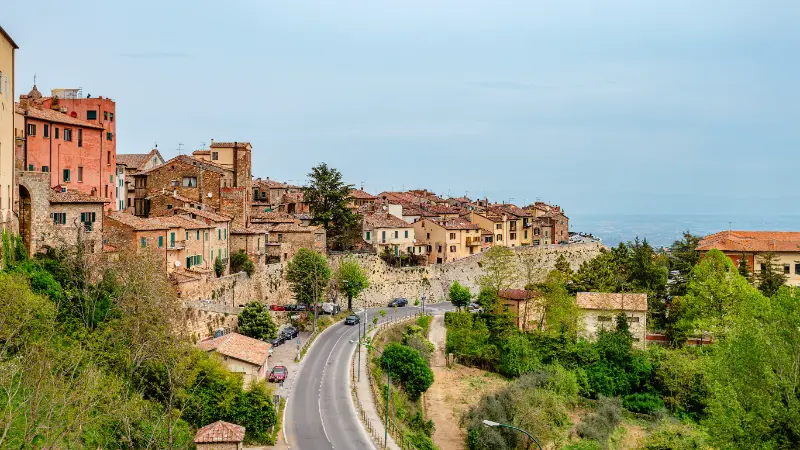
Along the way you pass cafés, enotecas and palaces whose façades are easy to miss if you are focused only on reaching Piazza Grande. Pause at side streets where the buildings suddenly open to wide countryside views. Montepulciano is unusually good at creating these contrasts: dense stone lanes on one side, enormous horizons on the other.
Notice the Renaissance palaces along the Corso
Montepulciano’s main street is lined with aristocratic buildings that reveal the town’s Renaissance ambitions. Palazzo Avignonesi, Palazzo Bucelli and other façades turn the walk into an informal architecture tour. You do not need to identify every palace to appreciate the effect. Look for rusticated stone, formal doorways and coats of arms that show how families used architecture to announce status.
One of the pleasures of Montepulciano is that these grand buildings are woven into everyday life rather than isolated in a museum district. A doorway may lead to a wine cellar, a small shop or an apartment. The town feels layered rather than frozen.
Piazza Grande is the reward at the top
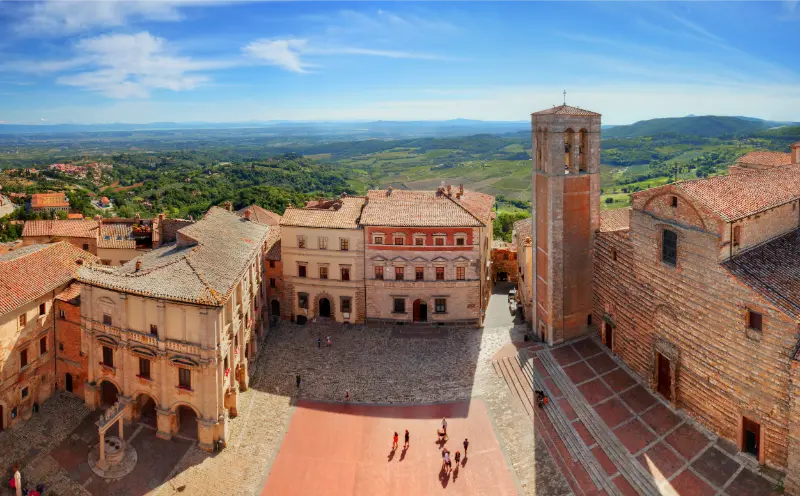
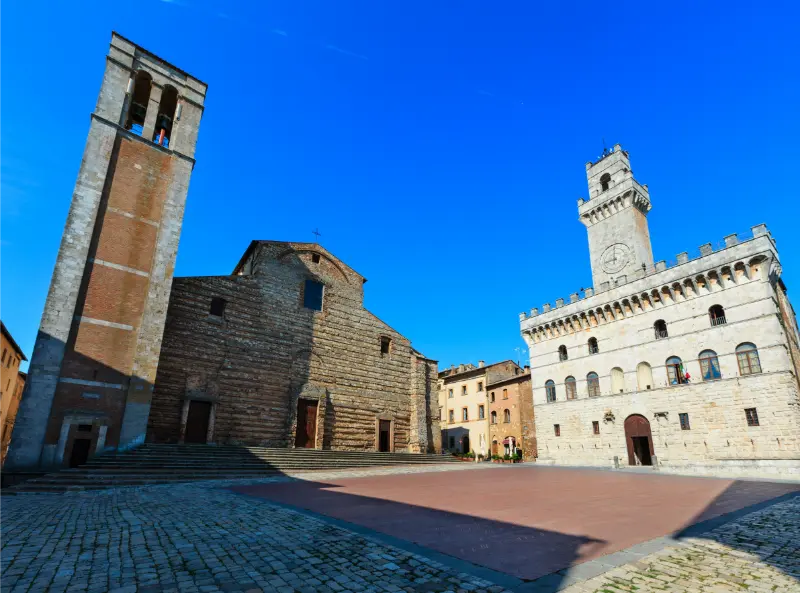
Piazza Grande sits at the highest part of the historic centre and is one of Tuscany’s most harmonious Renaissance spaces. The Palazzo Comunale, cathedral and noble palaces face a square that feels formal without being oversized. After the narrow climb, the sudden openness is striking.
The façade of the cathedral is unfinished, which gives the building an austere appearance that contrasts with some of the surrounding palaces. Inside, look for works connected to the town’s religious and artistic history rather than expecting the decorative excess of a larger cathedral city.
If the Palazzo Comunale tower is open during your visit, the climb is worthwhile. From the top, rooftops drop away toward a landscape of fields, vineyards and distant hills. It is the view that best explains Montepulciano’s strategic position between two valleys.
Go underground into a historic wine cellar
Some of Montepulciano’s most memorable spaces are beneath street level. Historic cellars extend under Renaissance palaces, with vaulted rooms carved into the rock and enormous oak barrels ageing Vino Nobile di Montepulciano. The name is important: this is Vino Nobile country, not Brunello, which belongs to Montalcino.
You do not need to be a wine expert to enjoy a cellar visit. The architecture alone is fascinating, and a short tasting provides context for the vineyards you see from the town walls. If you are driving, keep the tasting modest or arrange your day so the car stays parked until the evening.
Walk down to San Biagio
Below the historic centre stands the Temple of San Biagio, a Renaissance church surrounded by open countryside. Its symmetrical architecture and warm stone make it one of the most photogenic buildings around Montepulciano, but the setting is as important as the church itself.
You can walk down from the centre, although remember that the return is uphill. The route is particularly pleasant in spring or early autumn, when temperatures are gentler. If you have limited mobility or a tight schedule, reaching the church by car may be more practical.
Try to see San Biagio late in the afternoon. The façade catches warm light and the atmosphere becomes quieter as day visitors begin to leave the area.
Do not miss the views hidden between buildings
The classic mistake in Montepulciano is to focus so much on monuments and wine shops that you forget to look sideways. Small terraces and openings between houses reveal huge views. The direction toward Val d’Orcia feels softer and more rolling; toward Val di Chiana the landscape opens broadly toward distant ridges.
One of the best habits here is simply to take any promising side lane for two minutes. If it ends at a wall or doorway, turn back. If it opens to a panorama, you have found the kind of moment that makes the town feel personal rather than checklist-driven.
Explore the quieter upper streets after the main square
Many visitors reach Piazza Grande, take photographs and immediately start descending. Instead, spend another half hour around the upper lanes. The steep streets behind and beside the square are quieter, and they offer unusual angles on rooftops and towers.
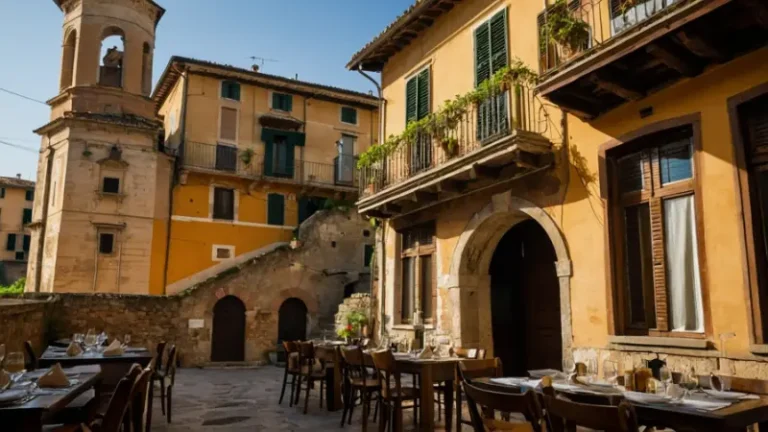
In the evening, this part of town is especially atmospheric. Stone façades hold the last light, restaurant tables begin to fill and the day-trip rhythm changes into something slower. Montepulciano is one of the Tuscan towns where staying for dinner genuinely improves the visit.
Where to eat in Montepulciano
Osteria Acquacheta, at Via del Teatro 22, is a long-established choice known for hearty Tuscan cooking. It is informal, lively and particularly associated with meat dishes. The experience is intentionally convivial rather than polished, so it suits travellers who want character more than formality.
If you prefer a restaurant close to San Biagio, Ristorante La Grotta, at Via di San Biagio 15, offers a more refined setting just opposite the church. It can work beautifully for lunch before walking back toward the historic centre.
Useful booking tools for this trip
Tours & experiences: For guided visits, attraction tickets and bookable experiences in Montepulciano, See tours & tickets
Where to stay
Palazzo Carletti, at Via dell’Opio nel Corso 3, is a distinctive option inside the historic centre. Staying in a historic palazzo fits Montepulciano particularly well, and the central location means you can enjoy the main streets before and after the busiest hours without moving the car. Check Palazzo Carletti prices & availability
If you prefer countryside and parking space, the surrounding estates and agriturismi are excellent alternatives, but staying inside town for one night gives you access to an atmosphere that most day visitors miss.
Where to park in Montepulciano
Do not aim your navigation directly at Piazza Grande. The upper historic centre includes restricted and narrow streets, and trying to drive as close as possible usually creates more stress than it saves. Follow the municipal parking signs around the lower edges of the old town and continue on foot.
A useful strategy is to choose a car park near the lower entrances, walk uphill through the town and then return slowly, stopping for views and shops on the descent. If you are staying at a hotel inside the historic centre, ask the property for precise arrival instructions before entering any restricted area. Local access rules matter more than what a generic navigation app suggests.
How much time do you need?
A half day is enough for the main street, Piazza Grande and perhaps a cellar, but Montepulciano deserves a full day if you want to include San Biagio, lunch and a slower walk. The town is compact on a map yet physically demanding because of the slopes, so an overpacked itinerary quickly becomes tiring.
If you are exploring southern Tuscany, Montepulciano pairs naturally with Cortona on a longer route through the Valdichiana, but I would not squeeze both into a rushed morning-and-afternoon schedule unless you are comfortable with a fast pace.
A route that makes the town easy to understand
Begin at Porta al Prato and follow the Corso uphill. Stop at the palaces and viewpoints rather than walking continuously. Reach Piazza Grande, visit the cathedral and climb the Palazzo Comunale tower if available. Explore one historic wine cellar, then descend toward San Biagio. Return for an aperitivo or dinner inside the walls.
The town’s greatest pleasure is the transition between experiences: an elegant palace followed by a rough stone alley, a dark cellar followed by a sunlit valley, a formal Renaissance square followed by a simple glass of wine. Montepulciano is beautiful because the architecture and landscape are inseparable, and the best visit gives both enough time.
Visit early or stay late for a completely different atmosphere
Between late morning and mid-afternoon, the main Corso can feel busy, especially in summer and during wine-related events. Early morning is quieter, but evening may be even better because the town remains lively while most excursion buses have gone. Piazza Grande under soft evening light has a dignity that is difficult to appreciate when it is crowded at noon.
If your itinerary allows it, make Montepulciano the place where you slow down rather than another stop between Florence and Rome. Have a long dinner, walk back through the centre after dark and notice how quickly the Renaissance façades become dramatic under simple street lighting. That final walk is often more memorable than another hurried attraction.
Want more accommodation options? Where to Stay in Val d’Orcia: Pienza, Montalcino, San Quirico or the Countryside? compares the best bases and makes it easier to choose the right location before you book.