What to See in San Gimignano: Towers, Frescoes and the Tuscany Behind the Postcard
San Gimignano is the Tuscany that many travellers imagine before they ever set foot in the region: stone towers rising above vineyards, narrow lanes climbing between medieval houses and a skyline that seems almost too perfectly preserved to be real. Yet the town is much more rewarding when you stop treating it as a postcard. Behind the famous towers are frescoed churches, small viewpoints, old fountains, local wine and streets that become remarkably peaceful as soon as you step away from the main route.
Its wealth grew during the Middle Ages, when San Gimignano stood on the Via Francigena and prospered through trade and agriculture. Powerful families built tower houses as symbols of status and security, creating the vertical silhouette that still makes the town instantly recognisable. A remarkable group of those towers survives today, while the historic centre has been protected as a UNESCO World Heritage Site since 1990. The best way to visit is to understand that the skyline is only the beginning.
Enter slowly and let the towers appear above you
If you arrive from the south, the approach through Porta San Giovanni is a good introduction. Via San Giovanni leads gradually uphill through shops, stone façades and occasional glimpses of towers. It can be busy in the middle of the day, but the architecture gives the walk a strong sense of arrival. Instead of hurrying directly to Piazza della Cisterna, look up at the different heights and shapes of the buildings. San Gimignano was designed vertically long before anyone thought of photographing a skyline.
Early morning changes the experience completely. Before day-trippers fill the main street, you can hear church bells, deliveries and footsteps echoing through the lanes. If you are staying overnight, this is one of the strongest reasons to choose a hotel inside the walls rather than visit only for a few hours.
Piazza della Cisterna is the heart of the town
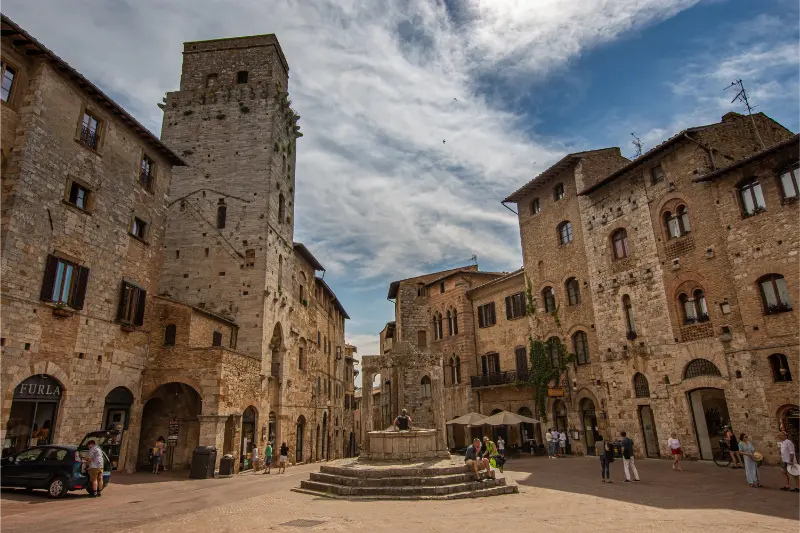
Piazza della Cisterna is one of the most beautiful medieval squares in Tuscany. It is triangular rather than perfectly symmetrical, edged by tower houses and palazzi that seem to lean toward the central stone well. The square takes its name from the cistern beneath it, and its slightly irregular shape is part of the charm.
This is where many visitors stop for photographs, but the square is more interesting if you spend ten minutes observing it. Notice the brick paving, the different windows and arches, and the way each building tells a slightly different period of the town’s history. In late afternoon, when the light warms the stone, it becomes especially atmospheric.
Continue to Piazza del Duomo and look beyond the façade
A few steps away, Piazza del Duomo feels more monumental. The Collegiate Church of Santa Maria Assunta is often simply called the Duomo, although San Gimignano is not a cathedral city. Its exterior is restrained, but the interior is one of the great surprises of the visit.
The walls are covered with cycles of medieval frescoes that turn biblical stories into vivid sequences of colour and human expression. The Chapel of Santa Fina, associated with Domenico Ghirlandaio, is particularly memorable. Even travellers who do not usually spend long in churches often find this one absorbing because the paintings feel almost like an illustrated story unfolding around the nave.
Give yourself time here. San Gimignano can easily become a rush from tower to tower, and the Collegiata is the place that best reveals how rich the town was culturally as well as economically.
Climb Torre Grossa for the view that explains San Gimignano
If you climb only one tower, make it Torre Grossa, attached to the Palazzo Comunale. It is the tallest tower in town and the panorama from the top makes the geography immediately clear: the clustered roofs sit on a ridge surrounded by vineyards, olive groves and rolling hills.
The climb is not effortless, especially on a hot afternoon, but it gives you the classic view without requiring a long hike outside town. Go earlier in the day if possible, both for cooler temperatures and softer light. From above, you can also see how compact the historic centre really is, which helps you realise that there is no need to hurry between sights.
Visit the Palazzo Comunale and the civic museums
The Palazzo Comunale is worth more than a quick stop on the way to the tower. The civic museum contains rooms decorated with frescoes and works that explain the political identity of medieval San Gimignano. It is a useful counterpoint to the religious art in the Collegiata: together, the two places show how civic ambition, faith and family power shaped the town.
If you are visiting in peak summer, museums also provide a welcome pause from the strongest midday heat. Plan outdoor viewpoints in the morning and late afternoon, leaving interiors for the warmer part of the day.
Walk to Sant’Agostino for a quieter masterpiece
At the northern side of the historic centre, the Church of Sant’Agostino receives fewer visitors than the Duomo but should not be skipped. Its main artistic attraction is the cycle of frescoes by Benozzo Gozzoli illustrating the life of Saint Augustine. The church has a calmer atmosphere, and the walk there takes you through a less congested part of town.
Continue along Via San Matteo and small side streets rather than returning immediately to Piazza della Cisterna. This part of San Gimignano feels more residential, especially outside the busiest hours, and it is easier to notice doorways, workshops and fragments of everyday life.
Find the Rocca di Montestaffoli at sunset
One of the simplest pleasures in San Gimignano is the Rocca di Montestaffoli, the remains of a fortress just beyond the main squares. The green space around the ruins is an easy place to pause, and the elevated viewpoint looks across the countryside rather than only over rooftops.

Late afternoon is particularly beautiful. Instead of competing for a spot in the central squares, bring a bottle of water, walk up to the Rocca and watch the light move across the vineyards. It is also a good place to understand why Vernaccia di San Gimignano, the town’s historic white wine, belongs so naturally to this landscape.
Look for Via delle Fonti and another side of the town
Most visitors stay on the central spine between Porta San Giovanni and Porta San Matteo. A more unusual detour leads toward Via delle Fonti, where medieval public fountains sit below the historic centre. The covered basins were used for collecting water and washing, and the route gives you a different perspective on the practical life of a medieval hill town.
The descent means you will have to climb back up, but that is precisely why it tends to be quieter. Wear shoes with decent grip, especially after rain, and avoid treating every lane as a shortcut if mobility is an issue: San Gimignano’s slopes and uneven paving are part of its character.
Useful booking tools for this trip
Tours & experiences: For guided visits, attraction tickets and bookable experiences in San Gimignano, See tours & tickets
Leave room for Vernaccia and local food
San Gimignano is famous for Vernaccia, a dry white wine with a history stretching back centuries. Even if wine is not the focus of your trip, tasting a local glass here makes more sense than ordering the same wine randomly elsewhere in Tuscany. Look for an enoteca that serves by the glass so you can compare styles without committing to a full tasting.
The surrounding countryside also produces saffron, olive oil and classic Tuscan ingredients. Avoid choosing a restaurant only because it overlooks the busiest square. Some of the most satisfying meals are a street or two away from the central flow.
Where to eat in San Gimignano
Cum Quibus, at Via San Martino 17, is one of the town’s most highly regarded restaurants and is a good option if you want a more refined dinner rather than a quick tourist lunch. The setting is intimate and works particularly well if you are staying overnight, when you can enjoy the town after the day crowds have gone.

For a more relaxed Tuscan atmosphere, Le Vecchie Mura, at Via Piandornella 15, is known for its terrace and views. Booking ahead is sensible in high season, especially if you want an outdoor table.
Where to stay
Hotel Leon Bianco, at Piazza della Cisterna 13, has the rare advantage of putting you directly on San Gimignano’s most atmospheric square. Staying here means you can step outside early in the morning or late in the evening, when Piazza della Cisterna feels completely different from the middle of the day. Check Hotel Leon Bianco prices & availability
Another characterful choice is Hotel L’Antico Pozzo, at Via San Matteo 87, inside the historic centre. The location is convenient for Sant’Agostino and the quieter northern streets as well as the main monuments. Check Hotel L’Antico Pozzo prices & availability
Want more accommodation options? Where to Stay in Tuscany: The Best Areas for Every Kind of Trip compares the best bases and makes it easier to choose the right location before you book.
Where to park in San Gimignano
The historic centre is not the place to improvise with a car. Follow the official signs for the municipal car parks outside the walls. If you are planning a full-day visit, P1 Giubileo on the southern side is generally the most economical option and has more than 300 spaces. It is a few hundred metres from the centre; in the main season a local Citybus service can make the final stretch easier.
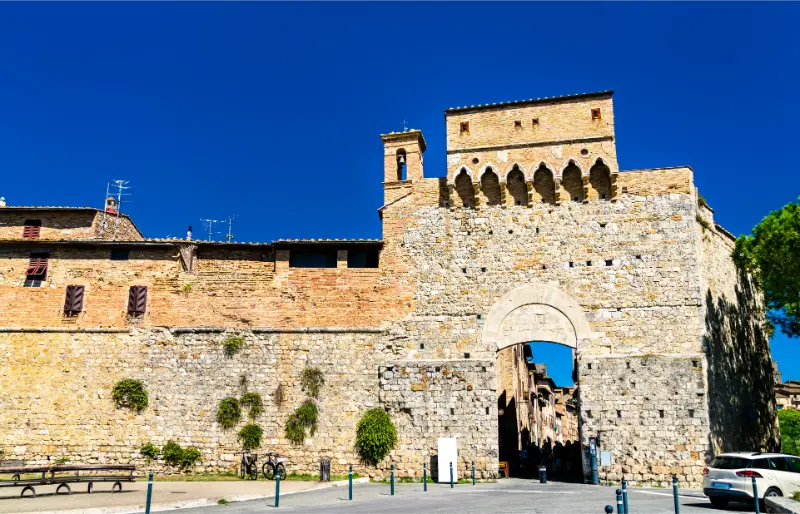
P2 Montemaggio is much closer to Porta San Giovanni but costs more, so it is useful when convenience matters more than price. On the northern side, the Bagnaia car parks are practical if your route approaches San Gimignano from that direction. Do not waste time circling the walls hoping to find an unofficial space: the signed system is much less stressful.
How much time do you need?
Three or four hours are enough to see the main squares, one tower and the Collegiata, but that schedule reduces San Gimignano to its headline attractions. A full day is better. It gives you time for Sant’Agostino, the Rocca, a proper lunch and a quieter detour without watching the clock.
An overnight stay changes the town even more. Day-trip traffic drops sharply in the evening, and the medieval streets regain a sense of stillness that is difficult to find at noon in summer. If San Gimignano is one stop on a broader trip, combine it with Siena rather than trying to squeeze three famous towns into the same day.
A simple route for your first visit
Start at Porta San Giovanni, walk Via San Giovanni to Piazza della Cisterna, continue to Piazza del Duomo and visit the Collegiata. Then climb Torre Grossa and explore the Palazzo Comunale. Have lunch away from the busiest square, walk north to Sant’Agostino and finish at the Rocca di Montestaffoli. If you still have energy, descend toward Via delle Fonti before returning to the centre.
San Gimignano is famous because of its skyline, but the town stays with you for smaller reasons: the frescoes in a dark church, the sound of footsteps under a stone arch, the view of vineyards through an opening in the walls. Treat the towers as an invitation rather than the entire story, and the visit becomes far richer.