What to See in Pitigliano: The Stone-Cliff Town That Feels Almost Impossible
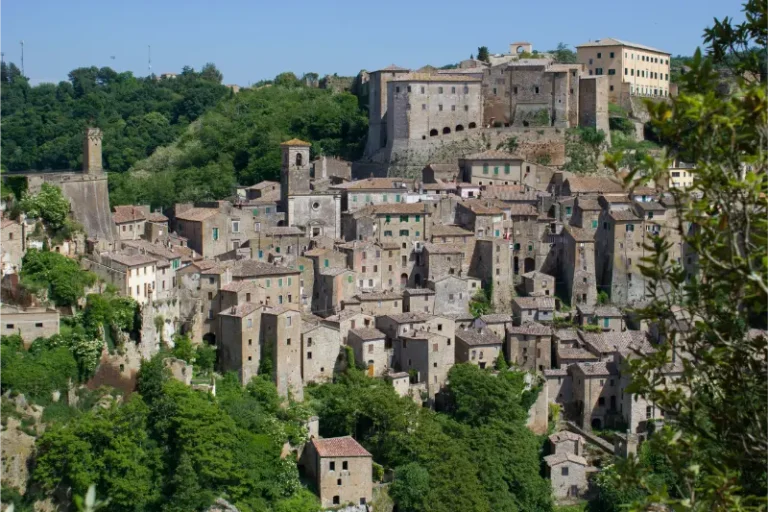
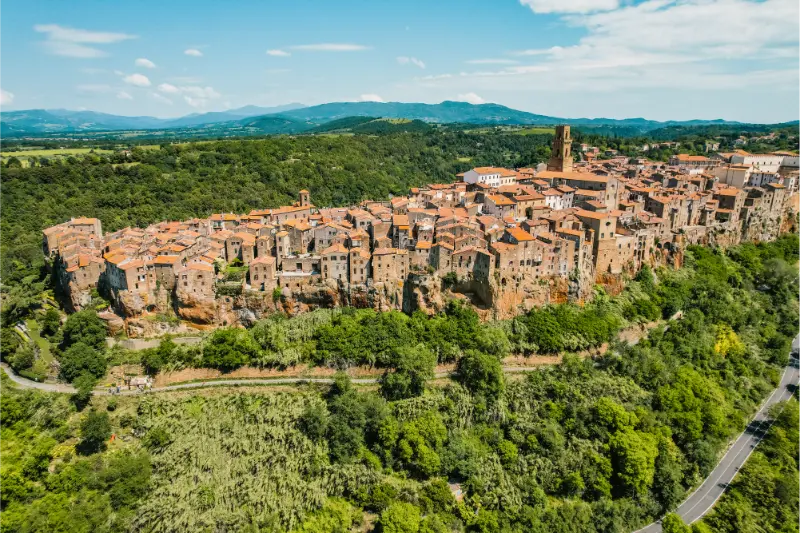
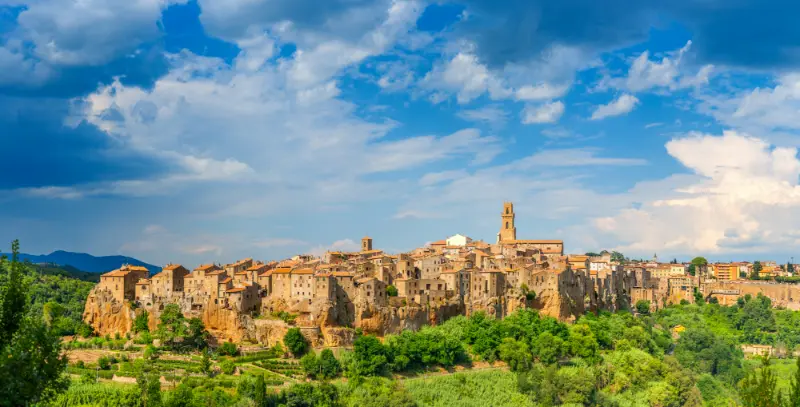
Pitigliano has one of the most theatrical arrivals in Tuscany. The historic town rises directly from a ridge of volcanic tuff, its houses appearing to grow from the same golden-brown cliff beneath them. Seen from the road before you enter, the effect is almost impossible: windows, walls and roofs seem suspended above deep green valleys.
The view is famous, but Pitigliano’s real fascination lies inside the rock. Etruscan paths cut deeply into the landscape, cellars and passages are carved beneath houses, medieval lanes follow the shape of the ridge and a historic Jewish community gave the town the nickname “Little Jerusalem.” This is southern Maremma at its most distinctive — less polished than the Val d’Orcia, more rugged and full of hidden layers.
Stop at the viewpoint before entering town
If you approach Pitigliano by road, do not drive straight into the parking area without first appreciating the classic panorama from a safe roadside viewpoint. The town’s position makes far more sense from outside than it does once you are among the lanes.
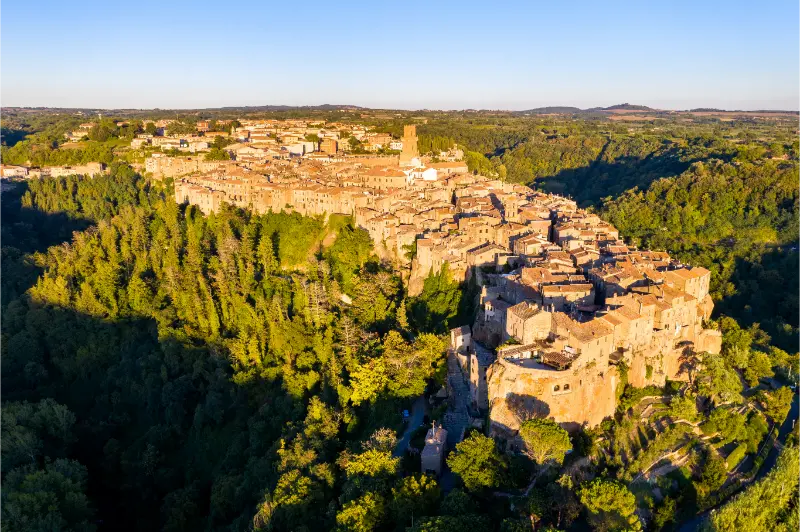
Morning and late afternoon produce the richest light on the tuff cliff. At dusk, the houses begin to glow while the valley darkens below them. If photography matters to you, build this stop into both arrival and departure rather than assuming you will get only one chance.
Cross the Medici aqueduct into the historic centre
The arches of the Medici Aqueduct form one of Pitigliano’s most recognisable architectural features. Developed to improve the town’s water supply, the structure creates a dramatic entrance toward Piazza della Repubblica.
Walk beneath and beside the arches rather than seeing them only from a distance. The engineering is particularly striking because of the town’s difficult terrain. Pitigliano was built on a narrow ridge, so moving water, people and goods required constant adaptation to geology.
Piazza della Repubblica and Palazzo Orsini
Piazza della Repubblica is the formal gateway to the old town. From here, Palazzo Orsini introduces the noble history of Pitigliano, with spaces that now host museums and collections connected with local art and archaeology.
The piazza is also a good place to orient yourself before entering the narrower streets. Once you pass deeper into the historic centre, the layout becomes more irregular, with alleys descending, turning and occasionally ending at dramatic viewpoints.
Walk to the cathedral without following the fastest route
The Cathedral of Santi Pietro e Paolo stands in the main historic area, but the walk there is more memorable if you avoid treating the street as a corridor between attractions. Turn into small side lanes, notice external staircases and look for openings that reveal the valley.
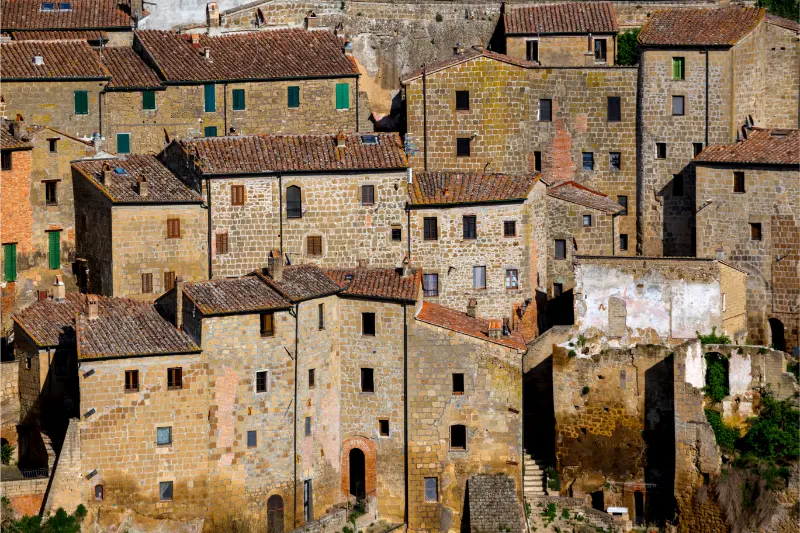
Pitigliano’s buildings are made largely from the same tuff as the cliff, which gives the town a visual continuity that is difficult to find elsewhere. Walls, caves and natural rock often seem to merge.
Discover the Jewish quarter and synagogue
Pitigliano’s Jewish heritage is one of the most important reasons to visit. A Jewish community became established here centuries ago and flourished particularly when restrictions elsewhere made the relatively tolerant Orsini territory a refuge. The historic quarter included a synagogue, ritual bath, bakery, cellar and spaces essential to community life.
The restored Synagogue of Pitigliano and connected spaces help tell that story. Visit with respect and give the area more time than a quick photograph. The nickname “Little Jerusalem” can sound picturesque, but behind it is a real history of coexistence, persecution, departure and memory.
Look beneath the streets
One of Pitigliano’s most unusual characteristics is the world carved into the tuff below ground. Cellars, storage rooms and passages have been cut into the rock for generations. Some are private, while others form part of museums, restaurants or accommodation.
If you stay overnight, ask your host whether the building has a historic cellar or cave space. It is a small detail that makes the geology of the town feel immediate. The cliff is not merely something Pitigliano sits on; it has been excavated and used as part of the architecture.
Walk one of the Vie Cave
Around Pitigliano, Sovana and Sorano, the Etruscans cut extraordinary sunken roads known as Vie Cave deep into the tuff. In places, vertical rock walls rise high above the path, creating an experience that feels closer to a canyon walk than a normal Tuscan trail.
These routes are among the most distinctive outdoor experiences in southern Tuscany, but use proper footwear. Surfaces can be damp, uneven and slippery, and mobile reception may be inconsistent in deeper sections. Choose a marked route appropriate to your time and ability, carry water and avoid beginning a long walk near dusk.
After rain, conditions can change. If a path is officially closed or looks unsafe, choose another route rather than climbing around barriers.
Taste the local food, including sfratto
Pitigliano’s cuisine reflects both Maremma traditions and Jewish heritage. One of the most distinctive local sweets is sfratto, a long pastry filled with honey and walnuts. Its history is connected with a painful episode in which Jewish residents were ordered into a ghetto, and the sweet’s baton-like shape recalls that story.
You may also encounter Bianco di Pitigliano, the local white wine denomination, as well as hearty Maremman dishes. Food here is at its best when it feels connected to place rather than presented as generic “Tuscan cuisine.”
Where to eat in Pitigliano
Trattoria Il Grillo, at Via Cavour 9, is a highly rated and popular choice in the historic centre, known for Tuscan and Maremman cooking. It works well for a substantial lunch after exploring the lanes.
Il Caveau, at Via Vignoli 146, is another well-reviewed option and its setting suits Pitigliano’s relationship with underground spaces. In peak periods, booking is sensible because the old town has limited dining capacity relative to visitor numbers.
Where to stay
La Casa degli Archi, at Vicolo Antico Pretorio 6, places you inside the historic town in a setting that matches the architecture around it. Staying in the centre allows you to walk the lanes after dinner, when most day visitors have left. Check La Casa degli Archi prices & availability
For a countryside option with easier car access, Country House Maremma Nel Tufo sits outside the centre along the SR74 and is highly regarded. This can be practical if your itinerary includes Sorano, Sovana and the Vie Cave. Check Country House Maremma Nel Tufo prices & availability
Want more accommodation options? Where to Stay in Maremma: Coast, Countryside, Hot Springs and Wild Tuscany compares the best bases and makes it easier to choose the right location before you book.
Useful booking tools for this trip
Tours & experiences: For guided visits, attraction tickets and bookable experiences in Pitigliano, See tours & tickets
Where to park in Pitigliano
Because the old town sits on a narrow ridge, parking strategy makes a real difference. The official visitor information lists several options. Piazza Dante Alighieri has free parking but can fill quickly. Via San Michele includes paid spaces, while Piazza Nenni is one of the larger convenient paid areas and also has spaces for campers.
A particularly pleasant choice is the parking around Via Santa Chiara, where free and paid areas are available. From here, a panoramic pedestrian route leads toward Piazza della Repubblica in roughly five minutes. Arriving this way gives you views before you even reach the main streets.
On weekends, holidays and summer days, arrive early. Do not attempt to push the car farther into the historic centre simply because a map shows a road; the narrow lanes are much better left to residents and authorised traffic.
Combine Pitigliano with Sovana or Sorano carefully
Pitigliano sits within the “tuff towns” area of southern Maremma, close to Sovana and Sorano. All three are worth seeing, but trying to explore them plus several Vie Cave in a single rushed day can become exhausting.
A good approach is Pitigliano plus one neighbouring town and one short archaeological walk. If you stay overnight, you can divide the area across two days and experience the old centre when it is quiet.
How long do you need?
Allow at least half a day for Pitigliano itself. A full day gives you time for the Jewish quarter, Palazzo Orsini, lunch and a short Via Cava. An overnight stay is ideal if you want to photograph the town at dusk and explore the surrounding Maremma without hurrying.
If Grosseto is part of your wider route, our Grosseto guide shows another side of Maremma, with Medici walls and a flatter urban landscape far from Pitigliano’s tuff cliffs.
A first visit route that flows naturally
Stop at the panoramic viewpoint before entering town, then park near Via Santa Chiara or one of the other signed areas. Walk to Piazza della Repubblica, see Palazzo Orsini and continue through the historic centre to the cathedral. Spend time in the Jewish quarter and synagogue, have lunch, then choose a manageable Via Cava for the afternoon.
Return to the viewpoint near sunset if light conditions are good. Seeing Pitigliano from outside after you have walked its streets is different from seeing it on arrival: the cliff is no longer simply beautiful. You know there are caves beneath the houses, layers of Etruscan history in the valleys and centuries of community life packed into the narrow ridge.
Why Pitigliano is one of Tuscany’s most memorable destinations
The town is visually extraordinary, but its real strength is how consistently the landscape shapes everything. The tuff determines the cliff, the streets, the underground rooms, the Etruscan roads and even the colour of the town.
Come for the impossible-looking panorama, but stay for the layers underneath it. Pitigliano is a place where geology becomes architecture and history is literally carved into stone. That makes it very different from Tuscany’s more polished Renaissance destinations — and, for many travellers, much harder to forget.