What to See in Prato: Medieval Treasures, Contemporary Art and a Different Side of Tuscany
Prato is one of the most interesting answers to a simple question: what does Tuscany look like when history is still part of a modern working city? Only a short distance from Florence, Prato combines a medieval centre, Renaissance masterpieces, a centuries-old textile tradition, contemporary art and one of Italy’s most important Chinese communities.
It is not a polished postcard destination, and that is a strength. The city has always been shaped by production and trade. Medieval merchant Francesco Datini built an international business network from here, while textile manufacturing later made Prato famous far beyond Tuscany. Today ancient walls and factory architecture coexist naturally, making the city feel more complex than many visitors expect.
Begin in Piazza del Comune
Piazza del Comune is the civic heart of Prato. Palazzo Pretorio, Palazzo Comunale and the statue of merchant Francesco Datini frame a compact square that immediately introduces the city’s medieval identity.
Enter the Museo di Palazzo Pretorio if you want to understand Prato through art. Its collection includes works by Filippo and Filippino Lippi, Donatello and other artists linked with the city. The building itself, with its layered medieval architecture, is part of the experience.
Walk to the Cathedral and look up at Donatello’s pulpit
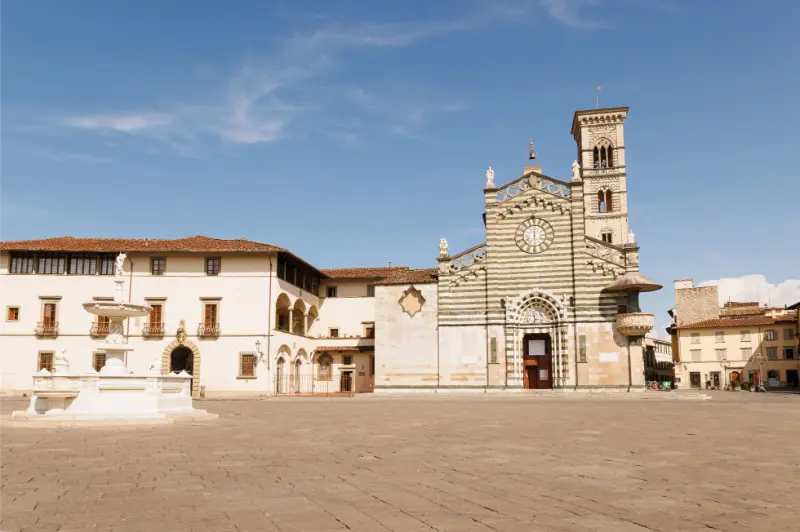
The Cathedral of Santo Stefano stands in Piazza del Duomo and combines Romanesque and Gothic elements. Before entering, look at the external pulpit created by Donatello and Michelozzo. It was designed for the display of the Sacra Cintola, the sacred belt of the Virgin that became central to Prato’s religious and civic identity.
Inside, Filippo Lippi’s frescoes in the main chapel are a major reason to visit. They have all the colour and narrative energy of the Renaissance, yet the setting is usually far less crowded than famous Florentine churches containing works of comparable importance.
See the Castello dell’Imperatore
A few minutes away, the Castello dell’Imperatore seems almost unexpected in Tuscany. Built for Emperor Frederick II, it is the only major Swabian castle of its kind in central Italy. The severe geometric walls contrast sharply with Prato’s churches and palaces.
Walk around the ramparts when access allows. The elevated perspective shows the cathedral, rooftops and surrounding city, helping you understand how the medieval centre fits within modern Prato.
Step into Santa Maria delle Carceri
Beside the castle, the Church of Santa Maria delle Carceri is a refined Renaissance building designed by Giuliano da Sangallo. Its balanced central plan feels almost serene after the fortress next door.
The pairing is one of the best small architectural sequences in Tuscany: imperial military power on one side, Renaissance harmony on the other, separated by only a few steps.
Visit the Museo del Tessuto
Prato’s identity cannot be understood without textiles. The Museo del Tessuto occupies part of the former Campolmi textile complex, an industrial building inside the medieval walls. Exhibits trace fabrics, techniques, fashion and production across centuries.
Even if you are not particularly interested in fashion, the museum is worth visiting because it explains why Prato looks and feels different from nearby art cities. Textile production did not simply create factories; it shaped migration, trade, architecture and the city’s modern economy.
Go contemporary at Centro Pecci
The Centro per l’Arte Contemporanea Luigi Pecci gives Prato another unexpected dimension. Its distinctive modern architecture and international exhibition programme make a strong contrast with the medieval centre.
Rather than treating the museum as disconnected from historic Prato, think of it as part of the same pattern: this has long been a city that makes things, trades ideas and looks outward. A visit is particularly worthwhile if your Tuscany trip is becoming overloaded with Renaissance churches and you want a completely different visual language.
Notice the city beyond the monuments
Prato is one of the best places in Tuscany to observe how an old centre lives alongside a multicultural modern city. Walk beyond the main squares and you will encounter textile businesses, bakeries, contemporary shops and a strong Chinese presence that has become an important part of local life.
Approach this side of Prato with curiosity rather than looking for a staged “ethnic quarter.” The city’s interest comes from the way communities overlap in everyday streets.
Where to park in Prato
Do not drive casually into the central ZTL. A practical option is Parcheggio del Serraglio, a large controlled-access parking facility near the northern edge of the historic centre. From there, the main sights are within walking distance.
Porta Fiorentina is another structured parking option close to the centre. If you are coming only for a day, parking once and exploring entirely on foot is the easiest approach.
Where to eat and where to stay
Osteria dei Francescaioli, at Piazza San Francesco 8A, is a well-regarded choice close to the centre for travellers looking for Tuscan cooking in an intimate setting. Its location makes it easy to combine with the castle and Santa Maria delle Carceri.
Boutique Hotel Enia, at Viale Montegrappa 124, offers a contemporary small-hotel option outside the tightest medieval streets and can be convenient for travellers arriving by car. Check Boutique Hotel Enia prices & availability
How much time should you give Prato?
A full day is enough for the historic centre, cathedral, Castello dell’Imperatore and Textile Museum. Add Centro Pecci and a slower exploration of modern Prato if you have a second day or a strong interest in contemporary culture.

Prato makes a particularly good day trip from Florence because the contrast is immediate. You are still in Tuscany, still surrounded by important art and medieval history, but the city’s rhythm is less touristic and more connected to work, manufacturing and present-day life.
Find more ideas in our Tuscany destination guides.
Useful booking tools for this trip
Tours & experiences: For guided visits, attraction tickets and bookable experiences in Prato, See tours & tickets
Follow the story of Francesco Datini
Prato’s history becomes more personal through Francesco di Marco Datini, the merchant whose statue stands in Piazza del Comune. His surviving business archive is extraordinary, documenting trade networks, letters, accounting and daily concerns across late-medieval Europe. He is a reminder that Prato’s international outlook did not begin with modern industry.
If you pass Palazzo Datini, pause to imagine the city as a commercial hub connected by correspondence and goods to places far beyond Tuscany. That continuity makes the modern textile city easier to understand.
Taste biscotti where they belong
Prato gives its name to biscotti di Prato, the crisp almond biscuits often called cantucci elsewhere. Traditionally they are enjoyed with Vin Santo, though they are just as good bought from a bakery and eaten later. The local version is worth trying because the texture and almond flavour can be much better than packaged tourist-shop biscuits.
Another local sweet is pesche di Prato, soft brioche-like pastries filled with cream and coloured to resemble small peaches. They make an excellent afternoon break after the museums.
Give the modern city a chance
Prato’s edges are not conventionally beautiful in the way of a hill town, but they tell the story of Tuscany as a region that produces, exports and changes. If you visit Centro Pecci, pay attention to the transition from medieval streets to wider modern roads and industrial buildings. The contrast is not a flaw in the itinerary; it is the reason Prato offers something genuinely different from Florence.

Prato is a strong choice for travellers who dislike crowds
The city is close enough to Florence to be extremely easy to reach, yet visitor numbers feel dramatically different. That makes major works such as the Lippi frescoes easier to appreciate and allows the squares to function as public spaces rather than constant photo sets.

If Florence feels intense after a few days, Prato can reset the pace without sacrificing culture. You still see medieval and Renaissance Tuscany, but with room to observe how people actually use the city.
How to arrive without a car
Prato has useful rail connections with Florence and other cities in northern Tuscany. Depending on your route, Prato Porta al Serraglio can be particularly convenient for the historic centre, while Prato Centrale serves wider connections. Arriving by train also removes any concern about the ZTL.
Once in the centre, nearly everything in this guide can be reached on foot. Centro Pecci sits farther out, so consider a local bus or taxi if you want to combine it with a full historic-centre day.
A simple one-day route
Begin at Piazza del Comune and Palazzo Pretorio, continue to the cathedral, then walk to Castello dell’Imperatore and Santa Maria delle Carceri. After lunch, visit the Textile Museum. If contemporary art is a priority, finish at Centro Pecci; otherwise spend the late afternoon wandering the centre and trying local sweets.
This route tells Prato’s story in chronological layers—from medieval merchants and sacred art to industrial textiles and contemporary creativity—without forcing the day into a rigid timetable.
One last reason to stay for the evening
After offices and museums close, Prato’s centre becomes pleasantly informal. Walk again between Piazza del Comune, Piazza del Duomo and Piazza San Francesco, then choose dinner without rushing for a train immediately after the last sight. The contrast between illuminated medieval façades and a genuinely contemporary city is clearest at this hour. Even a single overnight stay can turn Prato from an interesting day trip into one of the more surprising stops on a Tuscany journey.
Want more accommodation options? Where to Stay in Tuscany: The Best Areas for Every Kind of Trip compares the best bases and makes it easier to choose the right location before you book.