Best Castles and Fortresses in Tuscany: 10 Places Where History Still Feels Alive
Tuscany’s castles are easy to overlook because the region’s Renaissance cities attract so much attention. Yet the hills are full of fortresses built to control roads, valleys and borders that were once violently contested. Some survive as intact castles, others as powerful walls or military strongholds. Visiting them adds a different layer to a Tuscany trip: less polished than a palace, more closely tied to the geography you are driving through.
Why this experience belongs in your Tuscany trip
Poppi is the best all-round medieval castle experience; Monteriggioni is unforgettable for its walled silhouette; Fosdinovo combines a true castle with Lunigiana views; Montalcino and Radicofani give extraordinary panoramas. Brolio is particularly interesting if you want history and Chianti wine in the same day.
1. Poppi Castle
The Castle of the Counts Guidi dominates Poppi and the Casentino valley. Its thirteenth-century structure, courtyard, chapel frescoes and tower make it one of Tuscany’s most satisfying castle visits rather than merely a photogenic exterior.
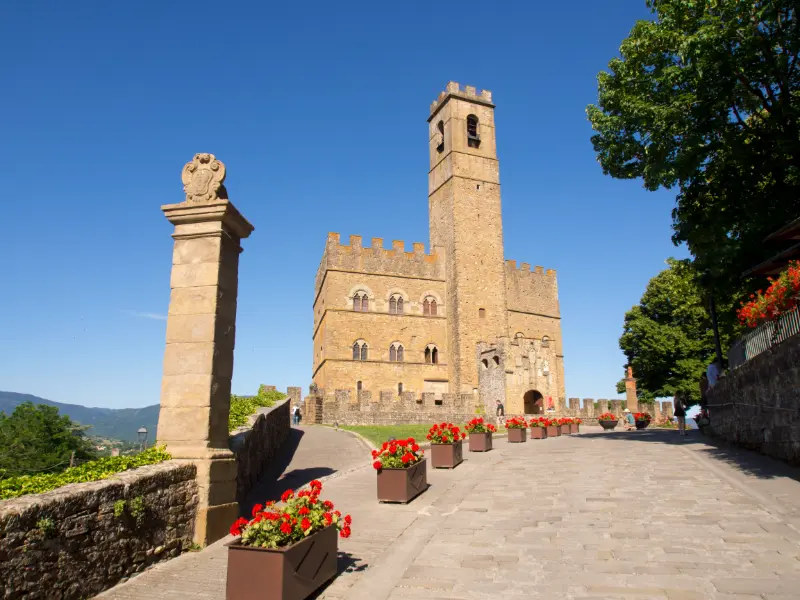
The historic centre is compact and steep in places. Park outside the oldest streets and allow time for the village as well as the castle. The official Visit Tuscany page lists the castle at Piazza della Repubblica 1.
2. Monteriggioni
Monteriggioni is technically a fortified village rather than a solitary castle, but its circular walls and towers create one of the most recognisable medieval profiles in Tuscany.
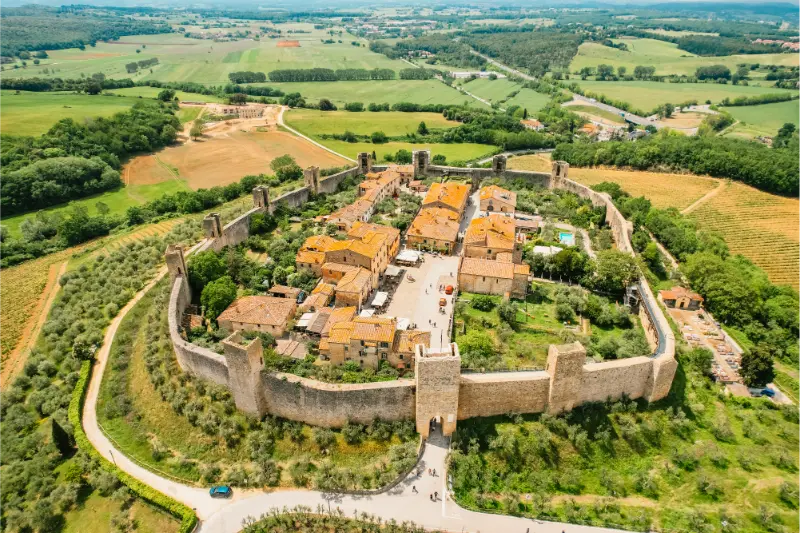
It is small enough to combine with Siena or San Gimignano, but that is also why midday crowds can feel intense. Early morning or late afternoon gives the walls more atmosphere.
3. Malaspina Castle, Fosdinovo
Fosdinovo rises above Lunigiana near the Ligurian border, and the Malaspina castle gives the town its dramatic identity. From this northern edge of Tuscany, the views stretch towards the Magra valley and coast.

Mountain and hill roads make journey times longer than the map suggests. Treat Fosdinovo as part of a Lunigiana day, not a rushed detour from central Tuscany.
4. Fortress of Montalcino
Montalcino’s fortress is a muscular reminder that this famous wine town was once strategically important. The walls and elevated position provide wide views across the surrounding countryside.
Combine the fortress with the town and one wine experience rather than scheduling several distant estates on the same day. Parking is outside the most restricted central streets.
5. Rocca di Radicofani
Radicofani’s fortress crowns a volcanic-looking hill above the old Via Francigena route. The height and isolation make the panorama as important as the ruins themselves.

The climb and exposed position can feel very hot in summer or windy in cooler months. Check access conditions before making a special journey.
6. Castello di Brolio
Brolio combines military architecture, aristocratic history and Chianti landscape. The estate is closely connected with the Ricasoli family and the story of Chianti Classico.
This is one of the castles where opening arrangements, tours and tasting options matter. Reserve the experience you want rather than arriving without checking what parts are accessible.
7. Castello dell’Imperatore, Prato
In the heart of Prato, this striking fortress commissioned for Frederick II brings imperial medieval history into a city better known internationally for textiles.
It is easy to reach by train from Florence, making it one of the simplest castle experiences for travellers without a car. Pair it with Prato Cathedral and the historic centre.
8. Fortezza Medicea, Arezzo
Arezzo’s Medici fortress sits above the city near the cathedral and Prato park, representing the later military history of Tuscany rather than the romantic feudal castle image.
Because it is inside an existing city itinerary, no special detour is required. Use our Arezzo guide to connect it with Piazza Grande and the major churches.
9. Rocca Aldobrandesca, Sovana
The ruins at Sovana introduce the powerful Aldobrandeschi family and the fortified history of southern Tuscany’s tuff towns. The setting is quieter and rougher-edged than the restored castles of central Tuscany.
Combine Sovana with Pitigliano and the Vie Cave, but do not underestimate the time needed for rural roads and archaeological stops.
10. Rocca Pisana, Scarlino
Above the Gulf of Follonica, Scarlino’s fortress ruins connect medieval defensive history with broad coastal views. It is a rewarding stop if you are already exploring northern Maremma or Cala Violina.
The village streets are steep and the strongest reason to come is the combination of fortress, old town and landscape. Avoid the hottest part of a summer afternoon.
How to plan it well
Castles make more sense when connected to the territory around them. Poppi belongs with Casentino, Fosdinovo with Lunigiana, Montalcino with Val d’Orcia and Brolio with Chianti. This produces a day with a story rather than a collection of unrelated monuments.
Opening hours at castles can be seasonal and individual rooms may close for events or restoration. Always check the official site on the day before travelling, particularly if the interior is the main reason for your visit.
Best time to go
Spring and autumn are ideal because many fortresses involve steep streets, exposed walls and outdoor viewpoints. Winter gives wonderful clear views but shorter opening schedules; summer requires water and more careful timing.
How to turn castle visits into a better Tuscany route
Think about Tuscany’s castles and fortresses as part of the wider itinerary rather than a standalone box to tick. Fortifications make most sense when they explain the valley, road or border around them, not when they are treated as isolated photo stops. A day becomes much easier when you decide in advance what the main experience is and what can remain optional. That matters in Tuscany because short distances on a map can hide slow roads, parking outside historic centres, queues at famous sites or long walks from the car. Give the main stop enough room to breathe, then add only one or two secondary ideas nearby. If everything goes smoothly you can always do more; if not, the day still feels complete.
For transport, a car is useful for rural strongholds, while urban fortresses in Prato and Arezzo are easier by train and on foot. Before leaving your accommodation, save the exact parking area, station, meeting point or trailhead rather than only the attraction name. This small habit prevents navigation apps from sending you through restricted streets or onto roads that are technically correct but impractical. In rural Tuscany, fuel, shade, public toilets and food options can be less frequent than visitors expect, while city centres often require the opposite strategy: leave the car outside and walk. The best choice is usually the simplest one, not the route with the most stops.
Booking is worth handling selectively. Check interior access and guided tours when the building itself matters; ruins and exterior viewpoints usually require less scheduling. Reserve what would genuinely disappoint you if unavailable, but do not schedule every hour. Tuscany is full of places where a long lunch, a sudden viewpoint or a small church can alter the plan for the better. Leave gaps between timed activities, especially if driving, and avoid stacking two high-demand reservations with no buffer. When opening hours or access rules matter, check the official source the evening before rather than relying on screenshots or old travel posts saved weeks earlier.
Timing can transform the same place. Late-afternoon light suits hilltop fortresses, but avoid arriving so late that the interior or tower has already closed. Early starts are useful for popular sites, but not every day needs to begin at dawn. Sometimes the better choice is a slow morning followed by a later visit when tour groups are leaving. In summer, use the hottest hours for lunch, museums or rest; in cooler months, make the most of shorter daylight. If photography matters, remember that Tuscany’s strongest light is often at the edges of the day, when stone, hills and water gain depth and the atmosphere becomes calmer.
The most common mistake is driving across the region for a single castle while ignoring equally good fortified sites near your existing route. A stronger approach is to choose quality over quantity and let the location set the pace. Wear shoes suited to uneven paving, gravel, wet surfaces or trails where relevant, carry water, and keep a light layer in the car because hill and coastal weather can change quickly. If travelling with children or anyone with limited mobility, check the final approach rather than assuming a place labelled accessible on a map is effortless in practice. Historic Tuscany is beautiful precisely because it was not designed around modern convenience.
Finally, combine military history with another interest—wine, landscape, walking or a nearby town—to create a fuller day. This is where personal travel style matters more than rankings. A visitor who loves art may happily spend three hours in one museum; another will remember the market outside more vividly. Some travellers want a polished spa or organised beach club, while others prefer a rough path to a natural pool or quiet cove. Use guides to understand the options, then choose the version that matches your energy, budget and route. The goal is not to reproduce someone else’s perfect Tuscany, but to make your own days feel coherent and enjoyable.
Useful booking tools for this trip
Tours & experiences: For guided visits, attraction tickets and bookable experiences in Tuscany, See tours & tickets
Useful official information
For Poppi Castle, start with the official regional page at Visit Tuscany, which also links to the Municipality of Poppi for current visiting information.
Where to stay for this trip: Where to Stay in Tuscany: The Best Areas for Every Kind of Trip. Check prices & availability
Final thoughts
The best Tuscan castles are not isolated attractions. They explain why towns sit where they do and why valleys, roads and borders mattered. Add one or two to a route and the landscape starts to make historical sense.