Val d’Orcia Scenic Drive: Best Route, Viewpoints and Stops
A Val d’Orcia scenic drive should not be planned as a hunt for one famous cypress photograph. The UNESCO landscape works because villages, wheat fields, clay hills, farm roads, chapels and ridgelines form one continuous scene. The best route therefore combines a few iconic viewpoints with towns where you actually stop, eat and walk.
This itinerary links Pienza, Monticchiello, Montepulciano, Bagno Vignoni, San Quirico d’Orcia and Montalcino. You can drive the full loop in a day, but the better version is to choose four major stops and leave room for unplanned viewpoints. For a multi-day stay, use our 3-day Val d’Orcia itinerary instead.
Val d’Orcia scenic drive at a glance
| Best starting bases | Pienza or San Quirico d’Orcia |
|---|---|
| Ideal duration | Full day |
| Best transport | Car |
| Core stops | Pienza, Monticchiello, Bagno Vignoni, San Quirico, Montalcino |
| Optional extension | Montepulciano |
| Best light | Early morning and late afternoon |
Why Val d’Orcia is a driving landscape
The Val d’Orcia cultural landscape includes municipalities such as Pienza, Montalcino, San Quirico d’Orcia, Castiglione d’Orcia and Radicofani. Public transport reaches some towns, but the famous visual rhythm of the valley lies between them. A car lets you stop when light changes, take smaller connecting roads and return to a viewpoint rather than treating each town as an isolated destination.

Read our Val d’Orcia travel guide first if you are still deciding which part of the valley to prioritise.
Stop 1: Pienza – begin with the big picture
Pienza is the ideal start because the historic centre is compact and the walk along the southern edge of town opens directly onto the Val d’Orcia panorama. Park outside the limited-traffic historic core, walk through town and use the viewpoint to understand the geography before you drive into it.
Allow 60–90 minutes for a first visit, longer if you stop for pecorino or lunch. Our Pienza guide covers the cathedral, Palazzo Piccolomini area and the lanes worth taking.
Stop 2: Monticchiello – the small-town contrast
Monticchiello is far smaller than Pienza and one of the best places to understand why the valley should not be reduced to famous towns. The road approaches through open countryside, then the stone village rises above the fields. Park outside the gate and walk the short historic core.
Thirty to forty-five minutes is enough for a simple stop. Do not use the saved time to add three more towns; use it to stop at viewpoints between here and the next destination.
Optional extension: Montepulciano
Montepulciano sits just outside the most concentrated Val d’Orcia circuit and adds a bigger Renaissance hill town. Include it if this is your only day in southern Tuscany. Skip it if you already have a separate Montepulciano day, because reaching the upper centre, parking and walking the steep streets can consume several hours.
See what to see in Montepulciano for a dedicated plan.
The Chapel of Vitaleta and the surrounding road
The small Cappella della Madonna di Vitaleta is one of the most recognisable rural landmarks near San Quirico. The chapel is important, but the larger lesson is to slow down on this section: individual cypress trees, farmhouses and field lines change with every bend.
Only stop where it is safe and legal. Do not block farm entrances or leave a vehicle partly on a narrow road just because a photograph looks attractive.
Stop 3: Bagno Vignoni – a thermal square, not a swimming pool
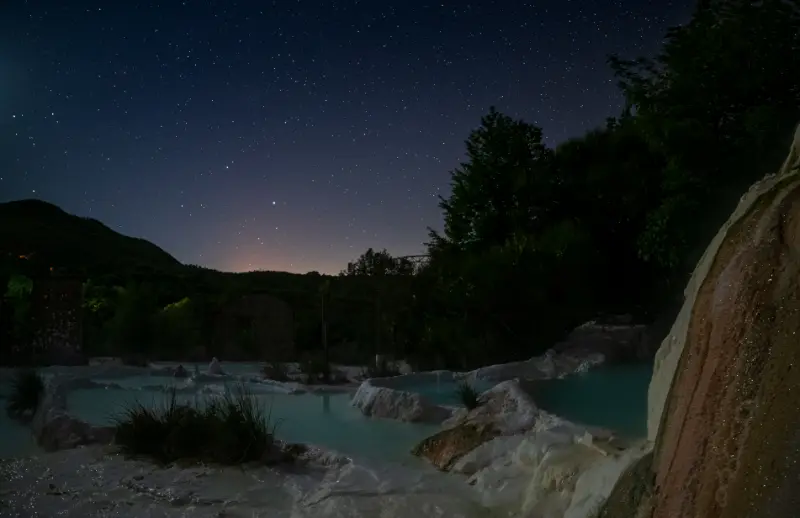
Bagno Vignoni breaks up the driving day perfectly. Its central Piazza delle Sorgenti is occupied by a historic thermal basin. You cannot bathe in the central pool; walk around the square and down toward the old mill area instead.

Allow about an hour if you are not booking a spa. If thermal water is a major interest, our Bagno Vignoni and Bagni San Filippo guide turns it into a full day.
Stop 4: San Quirico d’Orcia – the practical centre
San Quirico is strategically placed in the middle of the valley and has enough restaurants and services to work well for lunch. Walk through the historic centre and the Horti Leonini before continuing west.
Nearby countryside roads contain some of the valley’s most photographed cypress compositions. Again, use designated pull-offs and respect private land.
Stop 5: Montalcino – finish above the valley
Montalcino is an excellent final major stop because the town has a different character from Pienza: more vertical, more fortress-like and strongly associated with Brunello. The fortress area gives you a clear sense of elevation over the surrounding countryside.
Allow at least 90 minutes. If you want a proper wine tasting, make Montalcino a separate day or finish the driving route here and stay overnight rather than squeezing a serious tasting into the middle of a long self-drive day.
Use our Montalcino guide for the town itself.
A realistic one-day route
08:30: Pienza before the busiest daytime period.
10:15: drive via Monticchiello and stop for short walks/viewpoints.
11:30: optional Montepulciano only if you are willing to shorten later stops.
13:00: lunch around San Quirico or Bagno Vignoni.
14:30: Bagno Vignoni.
16:00: San Quirico and nearby countryside.
17:30: Montalcino for late-afternoon light and dinner.
In winter, shorten the route because daylight disappears much earlier. In summer, begin earlier and use the hottest midday period for lunch.
Roads and driving style
Main connections through the Val d’Orcia are manageable for normal cars. The scenic temptation is to leave them for gravel lanes; some are public, some are private farm access, and conditions can change after rain. Do not assume every white road shown by a map app is suitable for a rental car.
Our driving in Tuscany guide explains road signs and speed rules, while renting a car in Tuscany helps with the broader rental decision.
Photography strategy: light matters more than a pin
The Val d’Orcia can look flat and harsh at midday, then completely different two hours later. If photographs matter, prioritise early or late light. Morning suits Pienza and eastern sections; late afternoon can be beautiful around San Quirico and Montalcino. Weather and season change the direction and quality of light, so remain flexible.
Do not trespass into fields to reproduce social-media compositions. The fields are working agricultural land.
When to drive the Val d’Orcia
March–May: vivid green fields and variable weather.
June: long light and the transition toward golden landscapes.
July–August: dry, golden and hot; start early.
September–October: superb road-trip weather and warmer earth tones.
Winter: quiet, sculptural and atmospheric, but with short days.
Where to stay for the drive
Pienza is ideal for atmosphere and sunrise/sunset access. San Quirico is the most central. Montalcino works well when wine and the western side of the valley are priorities. A countryside agriturismo is best when the landscape itself is the reason for the trip.
Compare all options in our Where to Stay in Val d’Orcia guide.
Check Val d’Orcia stays & availability
Can you join a tour instead?
Yes. If nobody wants to drive, organised Val d’Orcia tours from Florence or Siena often combine one or more hill towns with food or wine. Check the exact itinerary before booking: a tour that includes three towns and a winery necessarily gives less independent time at viewpoints.
See Val d’Orcia tours & day trips
Common mistakes on a Val d’Orcia drive
- Trying to visit every famous town in one day.
- Stopping dangerously on narrow roads for photographs.
- Following unverified gravel-road shortcuts in a rental car.
- Scheduling a major wine tasting while still responsible for driving.
- Ignoring parking/ZTL signs at hill towns.
- Spending the entire day chasing photo pins and never walking through the villages.
The best version of the drive
The best route is not the one with the most stops. It is the one that gives you two substantial towns, one small village, one long lunch and enough empty space to stop when the landscape surprises you. If you have three days, stretch the same geography across multiple days rather than inventing new destinations.
Fuel, toilets and practical stops
Fill the tank before deliberately taking small country roads. Pienza, San Quirico and Montalcino have services, cafés and toilets, but a scenic lane between farms may have none. Keep water in the car and do not count on every viewpoint having a formal parking bay.
Val d’Orcia with an electric car
An EV can work well in Tuscany, but plan charging around towns and accommodation rather than expecting a charger at every rural stop. Check a current charging map before departure and choose accommodation with overnight charging if possible. Range drops faster than expected when you add hills, air conditioning and repeated detours.
What if the weather is bad?
Low cloud and rain do not necessarily ruin the drive, but they change the priorities. Spend longer in Pienza, Montalcino or Bagno Vignoni, shorten exposed photography stops and avoid questionable gravel roads. After heavy rain, dirt surfaces that were easy the previous week may no longer be sensible in a rental car.
- (‘val-dorcia-travel-guide’, ‘Read the Val d’Orcia travel guide’)
- (‘3-days-val-dorcia-itinerary’, ‘Follow the 3-day itinerary’)
- (‘bagno-vignoni-bagni-san-filippo’, ‘Add a thermal day’)
- (‘where-to-stay-in-val-dorcia’, ‘Choose your Val d’Orcia base’)
- (‘tuscany-road-trip-7-days’, ‘Build it into a Tuscany road trip’)